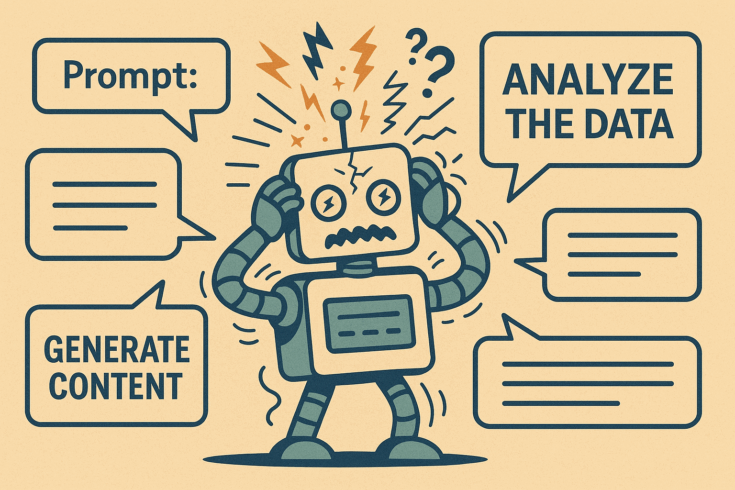
Does Your AI Output Feel Generic? Here’s Why.
 Lisa Heay
Summary
B2B marketers are quick to blame AI when the output feels generic, off-brand, or disconnected from their buyers. But often, the problem isn’t the tool, it’s what the tool was given to work with. The reference material powering your AI outputs like personas, messaging frameworks, voice guides, and competitive positioning is built by humans, maintained by humans, and when neglected, undermines everything AI touches. Here’s why the most important AI investment you can make right now has nothing to do with which model you’re using.
By Lisa Heay, Vice President of Business Operations at Heinz Marketing
You ran the prompt. You got the content. And it was fine…technically correct, grammatically clean, but completely forgettable.
It didn’t sound like your brand, it was dull, and it didn’t speak to the specific pain your buyers feel. It used the same buzzwords your competitors are using. And now someone has to spend an hour rewriting it before it goes anywhere near a campaign.
So you tweak the prompt, maybe you try a different tool, or a better model.
More likely than not though, the AI isn’t the problem. Your reference material is.

What is Reference Material?
In a B2B marketing context, reference material is everything you feed a model to help it understand your brand, your buyers, and your business.
Things like:
- Brand voice and tone guides
- Ideal Customer Profile (ICP) documentation
- Buyer personas
- Messaging frameworks and value propositions
- Competitive positioning docs
- Approved content libraries
- Customer interview transcripts and win/loss summaries
- Sales call recordings and enablement materials
Most B2B marketing teams have some versions of these. The problem is they were written by humans, for humans, often years ago, and haven’t been meaningfully updated since. They were built for a strategy meeting or an onboarding deck, not to power an AI content engine running at scale.
That distinction matters more than most teams realize.
AI Doesn’t Fill in the Gaps, It Draws Attention to Them
There’s a persistent misconception that AI is smart enough to compensate for weak inputs. It isn’t. AI is great at pattern recognition, synthesis, and execution, but it can only work with what it’s been given. When reference material is weak or outdated, AI doesn’t fill in those gaps, it amplifies them.
A persona doc written three years ago based on what your internal team thought the buyer cared about? AI will faithfully reproduce that outdated view across every piece of content it touches.
A messaging framework built around product features instead of buyer outcomes? Expect polished content that speaks to no one in particular.
A voice guide that says your brand is “approachable but authoritative” with no concrete examples? AI will default to the same bland terminology that makes your content indistinguishable from everyone else’s.
This is the real “garbage in, garbage out” problem, and it’s playing out in marketing departments across B2B right now.
Knowledge That Never Made It into a Document
Even teams with solid documentation are often missing the most valuable reference material of all: the institutional knowledge that lives in people’s heads.
For example, the sales rep who knows that digital transformation makes enterprise buyers roll their eyes, but “reducing manual handoffs” stops them in their tracks. Or the customer success manager who’s heard the same three post-purchase regrets on every onboarding call for two years. Or even the product marketer who sat in on a lost deal debrief and knows exactly which competitor’s talking point keeps directing business away.
Is all that reflected in your brand guide or persona doc? AI can’t surface it, infer it, or invent it. Only people can capture it, and someone has to do the work of turning it into usable reference material that reflects how your buyers think and make decisions.
The Human Foundation
This is the part of AI enablement most teams skip. Not because they don’t understand its value, but because it feels slow compared to the promise of instant, scalable content production. There’s no shortcut here, though…the human foundation has to come first.
AI should enhance your human work, not replace it. The goal isn’t to hand the keys over to the model. It’s to give it the best possible foundation to work from so your team can spend less time fixing output and more time on strategic thinking, relationship building, and the creative work that actually moves buyers.
What Happens When You Skip It
The downstream consequences are predictable and expensive.
- Content that sounds like everyone else. When your reference material lacks specificity, AI produces content that reflects the category average, not your point of view. Competent, but also completely forgettable.
- Messaging that misses the buying committee. B2B purchases involve multiple stakeholders with different priorities. If your personas haven’t been updated to reflect how that committee has evolved, AI-generated content will miss the mark for most of the people actually making the decision.
- Sales enablement materials reps won’t use. When AI-generated content doesn’t reflect real buyer language or common objections, reps can tell immediately. They’ll rewrite it themselves or ignore it entirely. This certainly doesn’t help with sales and marketing alignment which persistently plagues organizations.
- Campaigns that generate impressions but not pipeline. Reach is easy, but relevance is hard. Without a strong reference foundation, AI helps you produce more content faster, but faster production of the wrong content just burns more budget.
Building Your Foundation
The good news is this is fixable. It doesn’t require a massive lift, but it does require some attention, some thought, and the right processes in place.
- Start with an honest audit. Not what you think you have…what actually exists, how old it is, and whether it reflects your current ICP, messaging, and market position. Most teams are surprised by how outdated their foundational docs are when they really take a look.
- Capture that knowledge. Get the people closest to your buyers in a room: Sales, customer success, product marketing. Ask them what language buyers use, what objections come up every time, what competitors keep appearing in deals and why. Capture it and turn it into reference material AI can actually use.
- Pull from real buyer conversations. Your buyers are probably telling you how they think and talk about their problems. You likely have call recordings, customer interviews, win/loss summaries, forums, or reviews on sites like G2. That language is far more valuable in a reference doc than anything your internal team could write from memory.
- Designate a Reference Material Owner. It doesn’t have to be a full-time role, but it needs to be someone’s responsibility. Without ownership, these documents drift back toward outdated and irrelevant within a year.
- Treat it as a living document. Your reference material is not a set-and-forget kind of thing. Markets shift, buyer priorities evolve, and competitors change their positioning. Build a review cadence (at minimum quarterly) and assign someone to own it. If no one owns it, it won’t get done.
The Bottom Line
AI is an accelerant, but humans are the foundation. When AI could only help you write one blog post a little faster, weak reference material was a minor inconvenience.
But when AI is generating email sequences, ad copy, sales enablement content, and landing pages simultaneously, weak reference material becomes a much bigger and widespread problem that scales across everything you publish.
The teams that pull ahead over the next few years won’t necessarily be the ones with the most sophisticated AI tools. They’ll be the ones who did the human work first: capturing real buyer knowledge, building honest reference material, and giving their AI something genuine and useful to work with.
Want to talk through where your reference foundation stands and where to focus first? Email us for a free brainstorm session!