Agentic AI for B2B Marketers: Rethinking Your Resources & Tech Stack
 Sarah Threet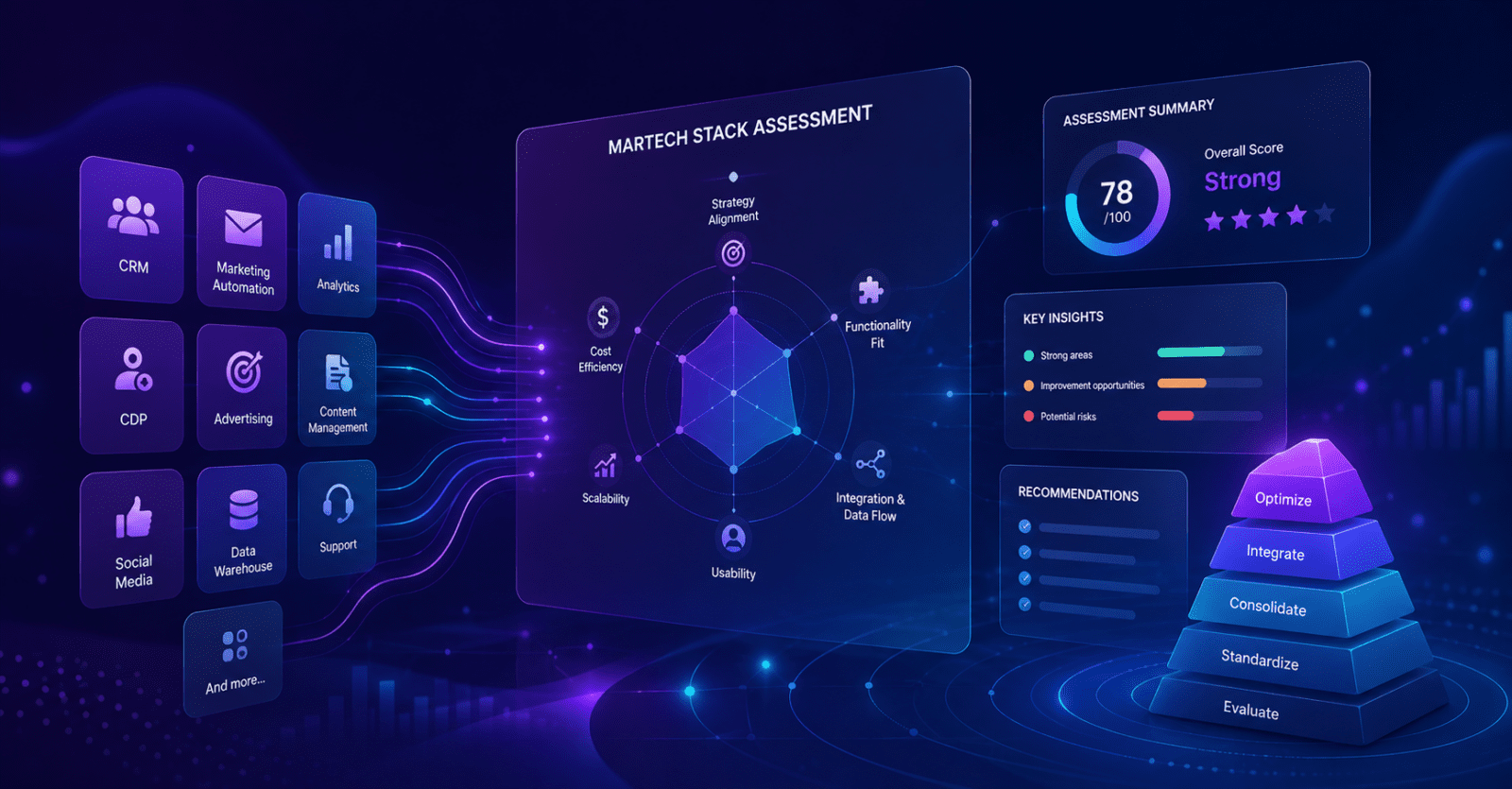
Summary
At Heinz Marketing, we’ve been thinking hard about where agentic AI delivers the most leverage for B2B marketing teams, and one of the most compelling answers is the tech stack itself. An agentic AI tech stack assessment could compress a multi-week project into days, surface redundancies humans miss, and turn stack rationalization from a one-time scramble into a repeatable practice. Here’s how it could work, and why we believe it matters.
By Sarah Threet, Marketing Consultant at Heinz Marketing
The average B2B marketing tech stack is a museum of decisions that made sense at the time… a platform someone signed up for two CMOs ago; a point solution that overlaps 80% with a tool you already pay for; an integration that was supposed to unlock attribution and never quite did… and every six months, somebody asks the inevitable question: “What are we actually using, and what is it costing us?”
Gartner’s 2025 Marketing Technology Survey found that the average organization is only using 49% of the capabilities in its martech stack, down from 56% the year before. More than half of every dollar going to marketing technology is generating no active output.
That work — auditing, mapping, evaluating — used to be a multi-week project. It’s the kind of thing that gets postponed because it feels too big to start. At Heinz Marketing, we’ve been building AI agents that take it on directly, and in this post, we’ll discuss our Resources and Tech Agent.
In the first post in this series, Payal (VP of Client Services, Heinz Marketing) walked through our Target Market Agent and how it compresses initial discovery from weeks to days. This post is about pointing the same kind of thinking at the tech stack itself.
What an Agentic AI Tech Stack Really Looks Like
You’ve probably heard that AI is going to transform martech. Most of what gets said about it is either too vague to act on or too hype-y to trust. Let me try to be specific.
A generative AI tool helps you write a vendor evaluation email faster. An AI agent does the evaluation. It looks at what tools you have, what they’re supposed to do, what they’re actually doing, where they overlap, where they fail to integrate, and what’s missing entirely. Then it produces a structured assessment you can act on.
The reason this matters for B2B marketers is that tech stack decisions are one of the highest leverage strategic moves a marketing leader makes. Get the stack right, and your team operates with speed and clarity. Get it wrong, bloated, fragmented, or under-utilized, and every campaign drags. Until recently, doing this evaluation rigorously meant either hiring a consulting engagement or pulling your team off the work that drives pipeline. Agentic AI changes the math. We’ve written before about why B2B CMOs need to take agentic AI seriously; applying it to the tech stack itself is one of the most concrete places to start.
What an Agentic AI Tech Stack Assessment Could Do
Imagine an AI agent purpose-built to assess a B2B marketing organization’s technology and resources footprint in a structured, repeatable way. The capabilities that would make it genuinely useful look something like this:
- Stack Inventory & Mapping: The agent ingests a list of tools the organization uses, pulled from contracts, login records, and integration documentation, and maps each one to the marketing function it actually serves — demand gen, content, attribution, enablement, ABM, and so on. The goal is a clean picture of what’s in the stack and what job each piece is doing.
- Capability Overlap Analysis: The agent flags redundancies, places where two or more tools do meaningfully overlapping work, and identifies which ones are likely candidates for consolidation. It doesn’t tell you which to cut, it tells you where the questions are.
- Capability Gap Analysis: Looking at the marketing motions the organization is trying to run, the agent identifies where the stack is missing capabilities entirely. If you’re trying to do account-based marketing without intent data, that’s a gap. If you’re trying to do lifecycle marketing without a journey orchestration layer, that’s a gap. The agent surfaces them.
- Integration & Data Flow Review: The agent assesses how data moves, or doesn’t, between systems. It maps where critical handoffs happen, and where data is getting stuck or duplicated. This is often where the real friction lives.
- Vendor Landscape Scan: When a gap is identified, the agent pulls in current information on category leaders and emerging vendors so the team has a starting point for evaluation rather than a blank page.
The output of that kind of agent would be a Resources & Tech Assessment Brief: a structured document covering current stack inventory, function-by-function coverage, redundancies, gaps, integration risks, and a prioritized list of recommendations ready to brief a strategy team.
Why This Matters More Than Most People Realize
The hidden cost of a sprawling marketing stack isn’t the software bill. It’s the dragging effect on every campaign, every report, every new hire. Teams spend cycles working around tools instead of working with them. Reporting takes longer because data lives in five places. New team members spend their first month learning the toolchain instead of contributing to it.
When organizations run this kind of stack assessment manually, it takes weeks. The right agentic AI tech stack approach could compress that into days while applying the same framework every single time. That consistency matters as much as the speed. When a CMO walks into a board meeting with a tech stack recommendation, the worst thing that can happen is for the board to ask a question the analysis didn’t anticipate. A structured, agent-produced brief covers the bases.
It also creates a baseline you can return to. Stack rationalization isn’t a one-time event, it’s something you should be re-running every couple of quarters as your motions, team, and budget evolve. With an agent doing the heavy lift, that becomes feasible instead of aspirational.
What It Would Take to Build an Agentic AI Tech Stack Agent
A few things would separate an agent that produces useful tech stack analysis from one that produces something glossy but wrong:
- A defensible taxonomy: Marketing technology categories overlap in messy, real-world ways. An effective agent needs a working taxonomy that maps tools to the actual jobs they do, not just the marketing categories they claim. That’s what lets the agent flag meaningful overlap instead of surface-level similarity.
- Strict sourcing on vendor information: The agent should pull from verifiable sources, like vendor documentation, public pricing pages, integration directories, and explicitly flag when something is unclear rather than guessing. In B2B procurement, a hallucinated capability is the kind of thing that ends a vendor relationship after the contract is signed.
- Function-first, not tool-first reasoning: The agent needs to evaluate whether a marketing function is covered, not just whether a tool is present. A team can own a great ABM platform and still have an ABM capability gap if no one is set up to operate it. The agent needs to surface that distinction.
- Human-in-the-loop calibration: The output should be a brief for a strategist to interrogate, not a recommendation to act on blindly. Any agent in this space worth its salt would be designed that way deliberately.
What This Means for CMOs and Marketing Leaders Right Now
If you’re a CMO or VP of Marketing, you already know the questions getting asked of you. Why are we spending what we’re spending on technology? Where is AI going to fit in our stack? What do we consolidate? These questions are going to get louder, not quieter.
An agentic AI tech stack approach lets you bring real answers to those conversations. You could run an honest stack assessment in a week. You could re-run it next quarter. You could hand new team members a brief that shows them the landscape on day one. And when budget season comes around, you could defend the line items that earn their keep and recover the ones that don’t.
For revenue and operations leaders, this is also where the data infrastructure conversation gets clearer. A lot of attribution and reporting pain is really tech stack pain in disguise. Surfacing it explicitly is the first step toward fixing it.
For agencies and consultants managing multiple clients, applying this kind of approach means tech assessment work could become part of an engagement instead of a separate six-week project. The scale and consistency of analytical work could grow without growing headcount proportionally.
What Humans Do Better (& Always Will)
Here’s the part of this conversation that doesn’t get said enough: an agent like this would map the stack; it would not decide what to do about it.
Choosing whether to sunset a tool that the sales team loves but marketing has outgrown is a human call. Executing proper change management is a human call. Negotiating with a vendor is a human call. Sequencing a stack migration so it doesn’t blow up a campaign cycle is a human call. Reading the room when leadership is attached to a particular platform is, very much, a human call.
What an agentic AI tech stack approach gives strategists is a defensible starting point: facts, structure, and a framing for the conversation. The judgment, the politics, the creative read on what’s actually possible inside a specific organization, that’s still ours. The best strategists we know don’t want to spend their days cataloging tools and clicking through vendor comparison sites. They want to think, advise, and create. That’s exactly what agentic AI gives them the space to do.
What We’re Exploring at Heinz Marketing and Where We’re Headed
We’re not making the case for agentic AI from the sidelines. We’re actively building, testing, and refining AI agents across the work we do for clients, and tech stack assessment is one of the most promising places we see for the technology to deliver real leverage. We’re moving deliberately in this space because the stakes are real, and an agent that gets the analysis wrong is worse than no agent at all.
We believe the marketing organizations that will thrive over the next 3-5 years are the ones that treat an agentic AI tech stack as core operating infrastructure, not a side experiment. They’re the ones that can move from question to grounded answer fastest, again and again. Agentic AI is what makes that pace sustainable, and a clear-eyed view of your resources and technology is what makes it possible in the first place.
Want to Talk About It?
If you’re a CMO, growth leader, or agency thinking about where agentic AI fits into your marketing operations or your tech stack, we’d love to compare notes. Email us at acceleration@heinzmarketing.com.