AI Is Making Your Best People Slower
 Matt Heinz
Summary
The tools are fine. We just forgot to factor in the cost of reading everything they produce. Three studies and four fixes below. Matt breaks down the “revision tax” on AI content — why faster drafts are creating a bottleneck at your best reviewers, and four ways marketing leaders are fixing it without slowing production down.
Our Friday CMO Coffee Talk sessions can be organized chaos. A live conversation on video while the Zoom chat goes nuts.
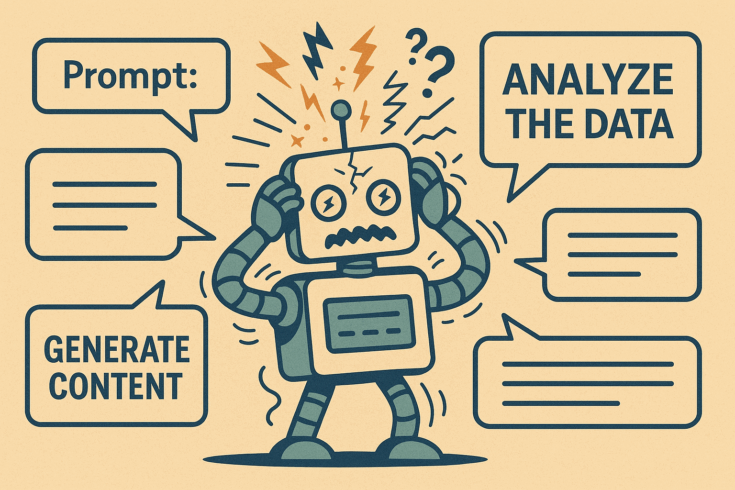
A couple weeks ago, the chat was filled with people tired of AI.
These weren’t skeptics or holdouts. They were marketing leaders running AI programs at their own companies, most of them still expanding those programs.
One described the volume of well-worded, impressively formatted documents landing on her desk that turn out to be slop, and the hours (plus the Claude credits) it costs her to deal with them. Another said flatly that his team isn’t allowed to send him AI-generated content, because he’s told them he won’t read it. A third admitted she’s now irritated by the act of reading AI at all.
Two of them apologized for being cranky. But they’re not wrong.
Speed was never the savings.
The AI ROI math is one-sided and incomplete
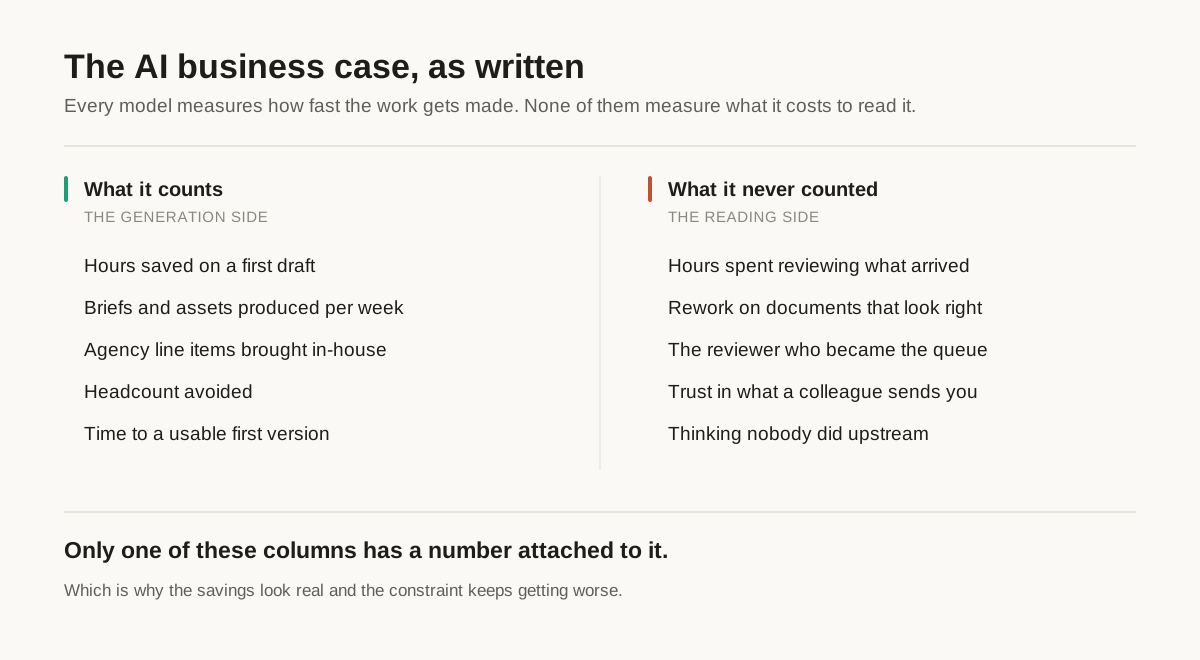
Just about every AI business case I’ve seen in B2B marketing so far measures a variation of the same thing: how much faster the work gets made. Hours saved on a first draft, assets produced per week, agency line items brought back in-house, headcount avoided. All valuable, and all of it sits on the production side of the ledger.
We forgot to consider the impact of now having to review ALL of that.
This was doable when the output was thinner. It stops being survivable when everyone on the team is producing several times their old volume and every bit of it still lands on someone whose day did not get any longer.
Somebody finally measured it
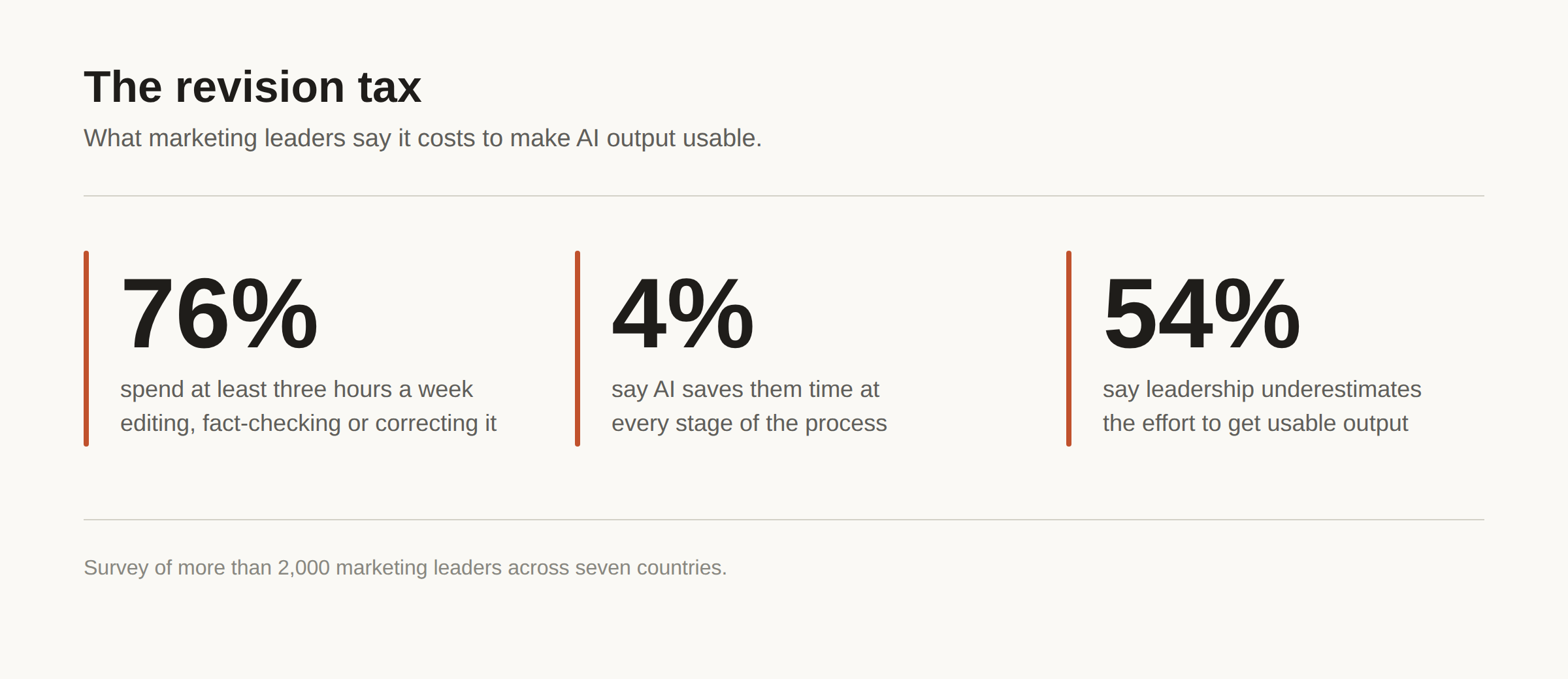
A recent global survey of more than 2,000 marketing leaders across seven countries found that 76 percent of them spend at least three hours a week editing, fact-checking or correcting AI output, and only 4 percent say AI saves them time at every stage of the process. The survey came from a company that sells AI marketing software, which makes the finding harder to wave off. They called it the revision tax.
In the same study, 54 percent of respondents say leadership underestimates the effort required to get usable output from AI.
Researchers at Stanford and BetterUp Labs recently put a definition on it: content that looks polished and carries no substance, quietly handing the thinking back to whoever receives it. They called it workslop.
In a survey of more than 1,000 desk workers, roughly 40 percent had received “workslop” in the previous month, at a cost of about two hours per instance. They priced it at $186 per employee per month, which runs to something like $9 million a year at a company of 10,000 people.
Why we all missed it
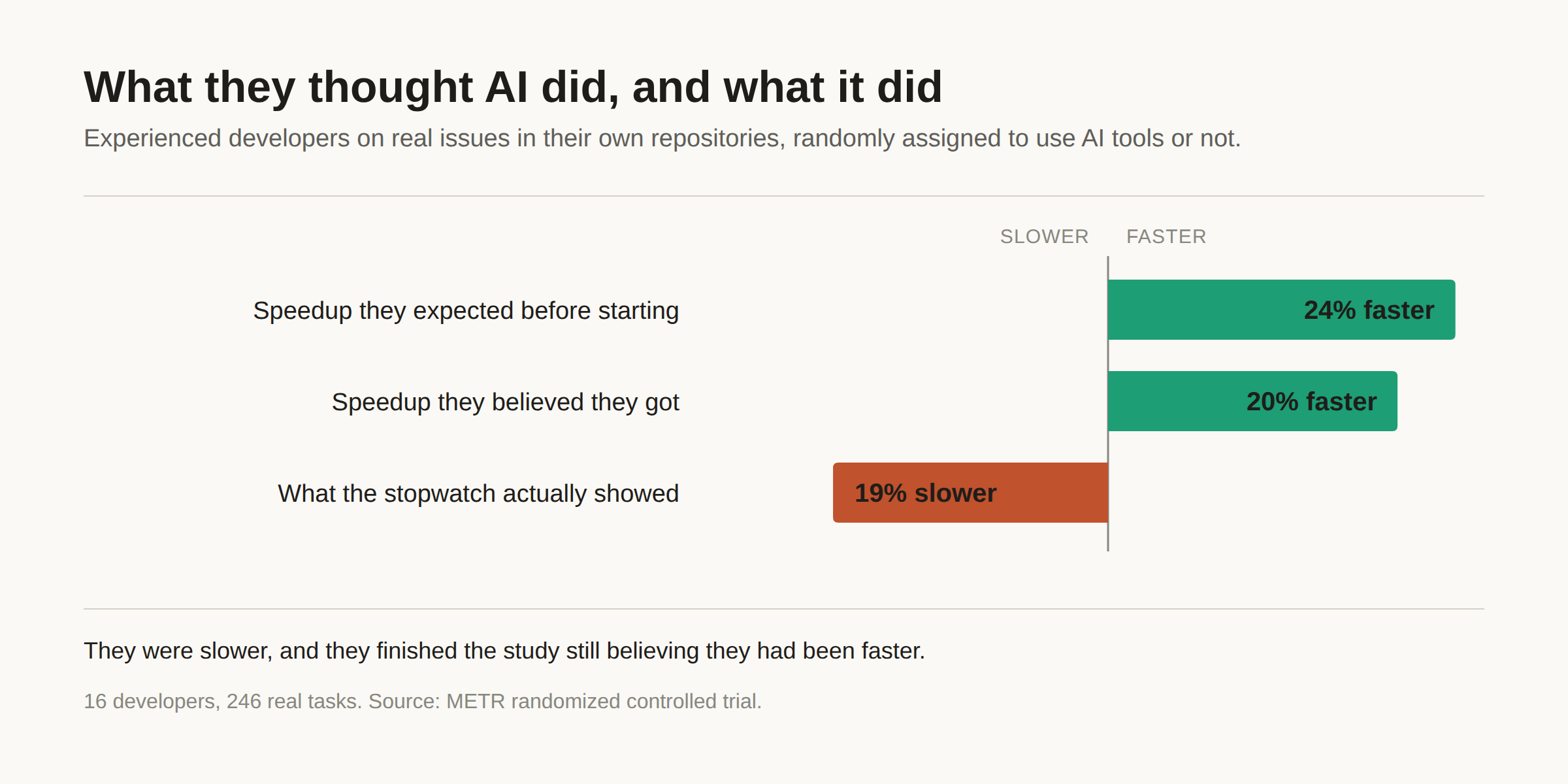
A dizzying example of this showed up in a recent randomized study of experienced software developers working on real issues in their own repositories. With AI tools, they took 19 percent longer to finish. Before they started they expected the tools to make them roughly a quarter faster, and afterward, having actually been slower, they still believed AI had sped them up by about 20 percent.
The gap between what they measured and what they felt is nuts.
We feel the generation but we don’t consider or quantify the cost of reading, because somebody else is doing it. The cost stayed out of the business case for a simple reason: the person creating the work is not the person paying for it.
Aaaand the constraint just got more crowded
Now run this math on your own team. Say eight people each producing four documents a day they’d never have attempted before, all of it flowing toward the one or two people who have to decide whether any of it is right.
Constraints don’t care how productive the stations upstream of them are. Speeding up everything in front of the bottleneck makes the queue longer and we know this from every other operational discipline. Marketing keeps rediscovering it.
Your most senior, most trusted reviewers are the choke point, and the AI program you funded made their job harder.
Volume you can’t defend
Have you heard the term “hollow expert” yet? The person producing a remarkable volume of work who can’t answer a question about any of it. This is how you scale mediocrity.
The fair objection here is the calculator one. Do you trust the colleague who used a calculator less than the one who did the long division? Of course not. But the calculator user still knows what the number means and why they needed it. That part didn’t get skipped, and it’s the part that shows up in the meeting when somebody pushes back.
Writing is thinking. Every document handed to a model is a document nobody thought all the way through, which is fine for a status update and really expensive for a strategy you expect to work.
Start with what doesn’t get sent
The leader who told his team he won’t read AI-generated content is doing quality control, and I’d defend that position in front of any board. His rule puts the cost back where the work was created: if you didn’t read or edit it before you sent it, he isn’t going to read it either. That one stand fixes the accounting problem at its root.
If you want the number that makes this case internally, put both halves on the same page: whatever hours your AI business case claimed to save, and what your reviewers actually spent reading the output. We built a revenue impact calculator that models the first half and has no line for the second, which should tell you how easy this is to miss.
A few other things I’ve watched work:
Build the context into the tools the whole company uses, not just the ones marketing runs. A lot of what marketing is cleaning up right now arrived from sales, product and CS, almost right, which is too often worse than wrong. Brand voice, positioning and operating context loaded everywhere means the first draft lands closer to usable no matter who generated it.
Make the edit count visible. A CMO recently started tracking how many edits she has to make to what lands on her desk and raising it in 1-1s. Not as a gotcha. As a signal for how much people should be reviewing their own work before it leaves their desk.
Ask what sucks before you accelerate anything. Some processes deserve to be stopped rather than sped up. Speeding up a broken one just gets you to the failure faster (with a much better audit trail). One leader recently got her directors in a room, asked them what sucks and went looking for AI to fix those things specifically, in that order. Starting from the pain solves the political problem for you too, because nobody argues with fixing the thing everyone already complains about.
This is orchestration work. Intake, work design, who owns what and where the context lives. Our team did exactly that for a 200-person marketing team that had already tried and failed at it more than once, and what came out was one intake for every request, trackable SLAs and capacity planning the execution team could believe. None of it is sexy. But it’s what separates a team that got faster from a team that got faster at the right things.
Plenty of people can produce at volume now. Far fewer can defend what they sent. I want more of the second kind in my inbox, and if AI helps get us there I’m all for it.
This post originally appeared on Matt Heinz’s Substack.