Brand Is a Dirty Word in B2B and That’s Our Fault
 Matt Heinz
Summary
Few can explain what it buys, so it keeps losing. Instead here are four things brand has to make true in your buyer's head, each one with a number you can build and justify. The case here reframes brand as four measurable states of buyer awareness — known, urgent, confident, obvious — each with its own leading indicator a CMO can track and defend to the CFO.
Many B2B CMOs don’t use the word “brand” anymore. Some in fact call it “demand creation” instead because brand had gathered too much baggage – especially with the CFO.
We can argue about whether the new name describes the work better than the old one did. Brand in B2B does create demand.
But ultimately this kind of renaming is a concession disguised as a vocabulary upgrade. It’s a mistake and frankly a big red flag if we stop defending a word in front of the CFO and then just smuggle the work in anyway under a name we think finance wouldn’t push back on.
And the thing about smuggling important work into the budget is that nobody, including your own team, is entirely sure what they signed up to deliver.
We narrowed what brand meant which is why it gets cut
Ten years ago, brand in B2B was largely defined as the identity system. The logo, the color palette, the tone of voice, the website refresh, maybe a campaign with an aspirational tagline that nobody could connect to a deal. That is still what a lot of executives, investors and board members hear when a marketer says “brand”.
Hard to defend in a tightening budget conversation, especially if attribution is nebulous.
But look at where the money goes.
Gartner’s 2026 marketing survey of 401 marketing leaders found awareness and conversion together accounting for 62.6 percent of total media spend, up more than 10 percent since 2024. Loyalty and retention are under 15 percent and down 29 percent over the same period.
The CMO Survey out of Duke’s Fuqua School, fielded in January with 308 US marketing leaders, found marketing spending growth at 1.7 percent, the weakest in several years, with more than 70 percent of respondents saying they prioritize immediate results over long-term gains.
And a real shocker (he says with tongue firmly in cheek): A 2025 EMARKETER and StackAdapt survey on B2B brand marketing found 62.7 percent of B2B marketers naming proof of ROI, not budget constraints and not economic uncertainty, as the top barrier to brand investment.
Put those together and we have a function that marketing leaders say is critical, nobody can measure, and we’re even going so far as to quietly rename it so it stops drawing fire.
The buyer’s short list predates anything “demand” can impact
Bain and Google surveyed 1,208 people involved in purchasing decisions at US companies across software, cloud, hardware, telecom, logistics and industrial equipment. The findings in Harvard Business Review showed 90 percent of buyers choose a vendor that was on a short list at the beginning of the sales process.
6sense’s 2025 Buyer Experience Report, roughly 4,000 responses with a median purchase value between $200-$300K, puts it sharper. Buyers pick from their Day One shortlist 95 percent of the time. The vendor they ranked first before any seller engagement wins more than 80 percent of the time. And first contact with a seller now happens around 61 percent of the way through the journey.
At any given moment roughly 95 percent of business buyers aren’t in market.
So a very small slice of your market is buying at any moment, and when they do start, the outcome is heavily shaped by what was already sitting in their heads before you got a vote.
Getting something useful into those heads, early, at scale and against a problem rather than a product, is the job. That has nothing to do with your logo or color palette.
Four things brand has to make true
I’ve been trying to build a framework that a marketing leader can take into a room with a CFO, because “invest in brand” is not an argument and “share of voice” is not an outcome anyone outside marketing is honestly moved by.
The version I like the most is four states of mind rather than four activities. Four things that have to be true inside your buyer’s head before they ever fill out a form, and each one has a number attached to it.
Known. Urgent. Confident. Obvious
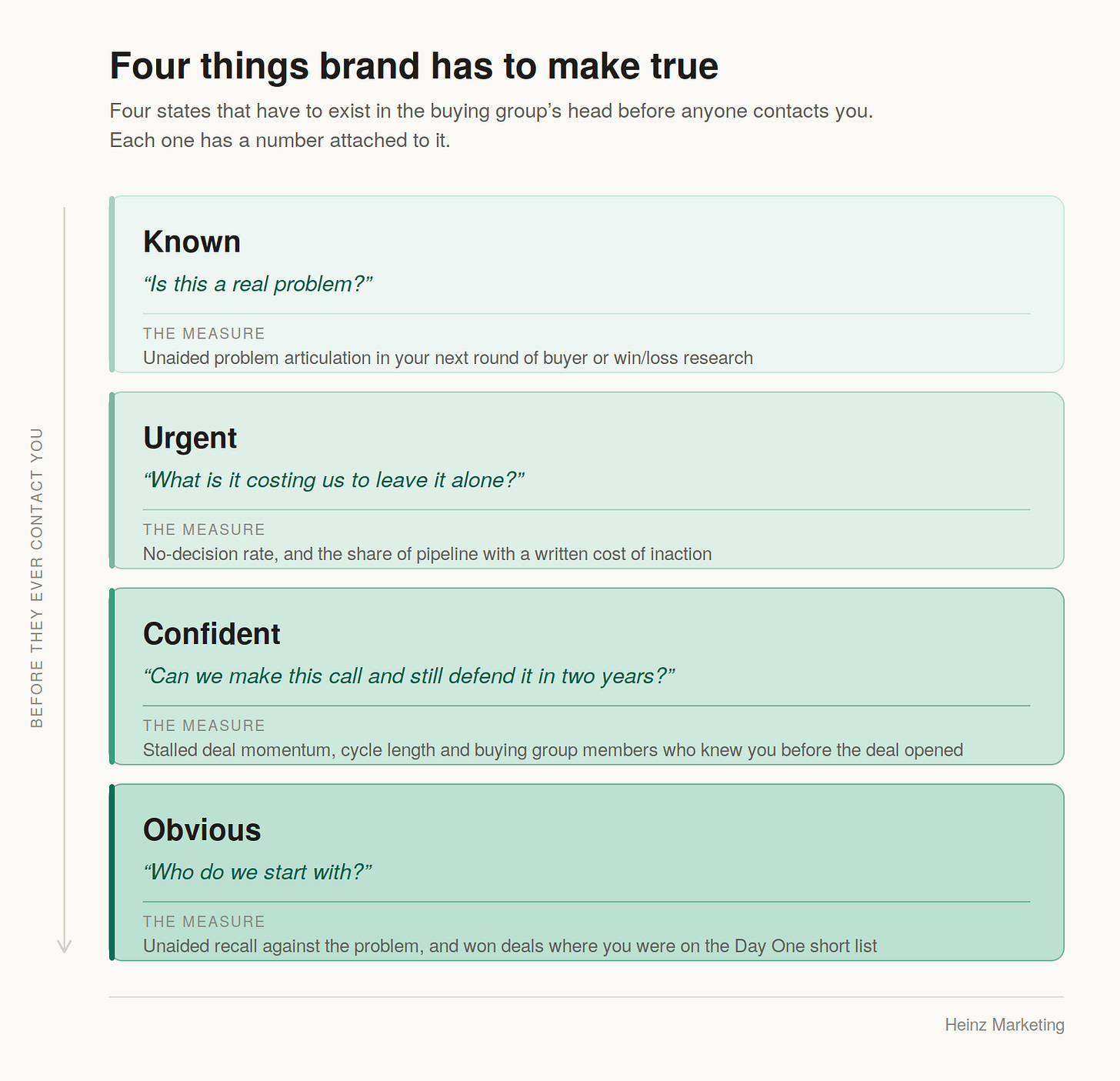
Known. Does the buying group know the problem is real?
Before anyone evaluates a solution, somebody has to believe there’s a problem worth solving, and be able to describe it. Category design people have been making this argument for a decade. Christopher Lochhead’s version is that legendary companies “educate the world about an idea or a problem” and win when the market accepts their point of view about it. He’s right and he got there first.
What’s changed in today’s market is that the education now happens almost entirely without you in the room. The buying group forms its understanding of the problem from analysts, peers, communities, search and increasingly from an LLM that has read everything except your gated whitepaper.
This is where thought leadership actually earns its keep. According to research from Edelman and LinkedIn, 79 percent of the people who influence purchases without ever appearing on a stakeholder map are more likely to advocate for a proposal from a company whose thought leadership they already consume.
Fifty-three percent of that survey’s respondents agreed that when thought leadership is genuinely high quality, brand recognition matters less. So this isn’t an argument for producing more of it.
The measure: unaided problem articulation. In your next round of buyer or win/loss research, ask people to describe the problem in their own words before you show them anything. Count how many describe it the way your category (or your own thought leadership) does.
That is a brand metric, you can directly impact it, and you can also ballpark the percent of the market (and therefore pipeline over time) it can help generate.
Urgent. Do they know what it costs to leave the problem alone?
A known problem that doesn’t hurt enough gets deferred forever, and deferral is where you lose most of your deals.
Matt Dixon and Ted McKenna, in their fantastic book The JOLT Effect, found that somewhere between 40 and 60 percent of deals end up lost to customers who expressed intent to buy and then failed to act. Of those no-decision losses, 56 percent came down to customer indecision rather than a preference for the status quo.
Those aren’t losses to a competitor, they’re losses to nothing at all.
Most of us are pretty good at making the case for our product and pretty bad at making the case for change. And let’s face it, the cost-of-inaction slides in our decks kinda suck and don’t move the prospect to action.
The measure: your no-decision rate, and the share of your pipeline where a quantified cost of inaction actually exists in writing. Both should already be in your CRM (and if they’re not, add this to your win/loss analysis).
Confident. Do they believe they can act without it blowing up on them?
This is where I’d spend the most time, and I want to be careful to credit it properly, because a lot of smart people have been working this ground.
Gartner found that customers reporting high decision confidence are 10 times more likely to make a high-quality, low-regret purchase. Brent Adamson, who wrote The Framemaking Sale with Karl Schmidt, put it about as directly as it can be put: the single biggest driver of purchase likelihood in a B2B sale is the degree to which customers feel confident about their own decisions.
Or as Mimi Turner at LinkedIn puts it, what buyers want most isn’t the best product or the best price, it’s a decision they can still defend in two years if everything falls apart.
And confidence is a group property, not an individual one. A 2025 Gartner sales survey of 632 B2B buyers found 74 percent of buying teams demonstrating unhealthy conflict during the decision. Same study: content tailored to the buying group lifted consensus about 20 percent, while content tailored to the individual moved it negative 59 percent. Hyper-personalization, done without any shared context, actively pulls a buying group apart, which is worth sitting with if your roadmap is built around one-to-one relevance.
The measure: stalled and no-decision rate, cycle length and the number of people in a closed-won buying group who had encountered you before the deal opened.
Obvious. When they think about the problem, do they think of you?
This is a mental availability argument and it impacts both acquisition and retention strength.
Ehrenberg-Bass surveyed US business insurance buyers across 17 product types and found that for each additional category entry point a customer links to your brand in memory, probability of defection drops roughly 5 percent. Bigger brands in that data don’t just have more customers, they have customers who connect them to more buying situations.
One really important distinction worth highlighting now.
The instinct is to hear “obvious” as declaring yourself the leader, and the newer buyer research keeps finding that self-declared category leadership underperforms relational proof. Peer recommendations and similar-company evidence move buyers considerably more than market-leader messaging does. The goal is being the name that surfaces when a specific problem does, which is a much smaller and more winnable fight than being crowned the biggest.
The measure: unaided recall against a problem statement rather than a category name, and the share of your closed-won deals where you were on the shortlist before anyone from your company made contact. That second number is sitting in your CRM right now and almost nobody reports it.
What all of this actually gains you in budget cycles
These are four progressive states of problem/solution awareness, prioritization and association that are measurable with data already in your systems or available with a simple round of customer and buyer research.
You don’t have to have the “brand is a long-term investment” talk anymore, which every CFO has heard and correctly hears as “I can’t tell you when but spend money anyway.” The better narrative is that 90 percent of the time the winner was already on the list, you can measure whether you’re on the list, and the work that gets you onto it has a name and that name is brand.
One honest caveat before you take any of this into a room. None of these four give you clean attribution. Your no-decision rate will also move when you hire a better enablement lead, and unaided recall shifts when a competitor starts spending heavily. These are leading indicators you can move on purpose and report on a cadence, not proof that brand did it. That’s still a far better conversation than the one most of us are having now.
And here’s a challenge for extra credit (and extra CFO confidence).
Set a baseline on all four brand stages before you ask for money, and be clear that two of them move slowly. Known and Obvious are memory problems and memory takes quarters to shift. Urgent and Confident show up faster, inside the deals you’re already running, which makes them the right two to lead with when you’re asking for the first dollar.
The programs that survive a budget cut are the ones carrying a before-and-after on a number somebody outside marketing already cares about. The ones that get cut were only ever described as important.
None of this is particularly sexy. But it’ll move the needle on whether the work gets funded next year.
Long live brand!
I understand the impulse to rename it. Demand creation is a good phrase, it’s accurate and it gets the budget approved.
But “demand creation” describes the output and says nothing about the mechanism, which means it will be measured like demand generation always has and be judged on the quarter, which is exactly the trap the rename was meant to escape.
Six months in, somebody will ask the demand creation team for pipeline this month, and the work that only pays off across a year of buying cycles will lose that argument too.
Brand is being known and understood as the best available answer to a problem your buyer already feels, by everyone who will be in the room when they decide. That job doesn’t get any smaller when we rename it, it just gets harder to explain to the people who fund it.
This post originally appeared on Matt Heinz’s Substack.