DACI vs. RACI: Using Both
 Tom Swanson

Summary
RACI breaks down in cross-functional marketing work: accountability dilutes with every handoff, and a single approver with sign-off power over subjective calls becomes a bottleneck. I’ve come around to using both models. DACI fits the overall workflow, splitting ownership between an Approver who owns results and the go/no-go decision, and a Driver who owns getting work done and escalating when it stalls. RACI still works inside individual teams that run like an assembly line. The short version: RACI within functions, DACI across them, with clear escalation paths in between.
By: Tom Swanson, Senior Engagement Manager at Heinz Marketing
Last month, I wrote about accountability and suggested defining it with a RACI. In that post, I shared how a RACI is more widely understood, but a DACI could fit for a specific team. My thinking on this has evolved, and I wanted to give more context on how B2B marketing teams can apply not just one, but both models to improve team function and quality of life.
I have mentioned it before, but I hate how similar these sound given the differences in how each model should be applied. Over the past 5 years, I have learned a lot about when to apply each, and I feel confident in saying there are times when it makes sense to use both. That’s right, both.
Here is a refresher on the things to consider for each.
For a B2B marketing team, or indeed any marketing team (I see you B2C folks), there are a lot of hands that touch work. The typical marketing team flow looks something like this:
- Strategy team decides what campaigns are going to run
- Tactical team decides what is going to go into that campaign
- Tactical team decides what is needed to support the campaign and routes to the creatives
- Creatives decide on priority and work order to meet deadlines and starts producing
- Tactical team decides when the creative is finished and ready to go
- Executing team decides how to set everything up
- Campaign goes live
- Profit… hopefully
Now there is obviously a ton of nuance and every team has different this or that. Some teams have integrated marketing that decides how to fit everything together. Some teams have ABX that decide what target accounts are going to see vs. the plebian mid-market and SMB.
But here is the deal: decisions are what drive a project forward.
DACI is a decision framework, and I have really come around to DACI as a model for an overall marketing workflow and how work moves between teams.
RACI assigns work more effectively, and is very strong for how work gets done inside a single team or function.
The problem is accountability
In the previous post, I wrote about how it is extremely common for teams to tell me that they have no accountability. Still true. Still the most common thing I hear. Honestly, me saying it in these posts is becoming a bit of a cliche.
Aside from being the most used word in so, so many reality TV shows, accountability has some real baggage as a term. Functionally, it means “whose ass is on the line if this all goes belly-up?”. Who wants that? Why do we ask for it?
Scott Galloway asked the best question “How can I increase my compensation while reducing my accountability?” This captures a lot of the sentiment that can creep into a team.
I am being a little dramatic here. I believe that most of us want accountability that feels reasonable given our scope. A RACI promises to bring that accountability and mark one person as accountable. However, when many, many hands are touching a project, how can the accountability for a step feel reasonable given an individual’s scope? When is it really the case in marketing that there is one point of accountability?
There isn’t, at least not in the sense that people tend to think of. RACI falls apart when assigned step-wise in cross-functional projects. Accountability can only function this way if it is paired with approval power, which in cross-functional teams leads to one outcome: tyranny. It is a dramatic term for this, but it demonstrates the issue of a single approver holding power over subjective decisions such as if creative is good enough.
The tyranny of the approver needs to be checked. We’ll get to that in a sec.
Marketing, as a single entity, simply is not the right model for a RACI. To boil it down, there are two things that are just inherent to marketing work that stymie a RACI:
- Failure to perform cannot be directly attributed to any one factor for certain
- This isn’t like if a screw wasn’t installed correctly. User sentiment, environmental factors, timing, competitive activity, and so many other external, market factors can impact performance.
- Work needs to change hands so many times that accountability gets diluted.
So what’s a team to do?
Decisions, Decisions, Decisions
This isn’t to say that accountability can’t exist in marketing teams. The real key is to eliminate, as much as possible, the dilution that occurs when accountability changes hands.
Recently, I have been highly focused on decisions as the mechanic for this. At the cross-functional level, accountability needs to sit with whoever has the decision power to decide if things are good enough/should move forward or not.
The way you can avoid this particular pitfall is by implementing checks on the tyranny of the approver. That requires someone who is diligent, fact-focused, and organized.
Oh hey, look, we’re talking about project managers again. A good PM owns escalation pathways that hold an approver accountable to knowing when good enough is good enough. The escalation paths need to be designed to engage the managers of all the currently active functions to determine where the fault lay and get around it.
DACI has this built into the Driver function.
The Split
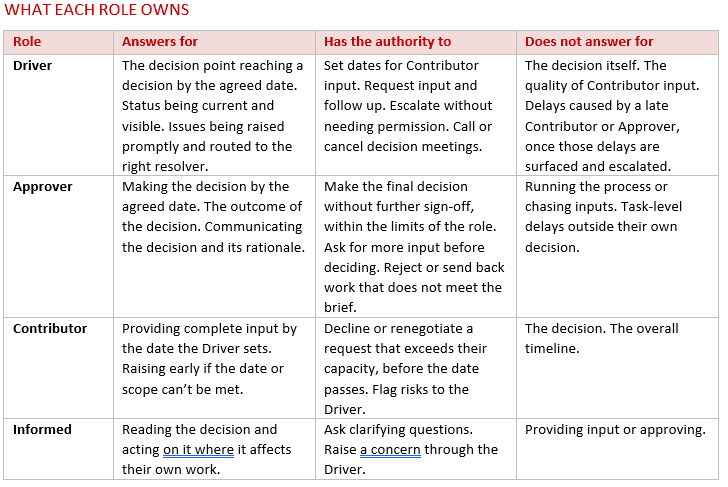
DACI is best for the workflow as a whole, where accountability to performance needs to sit with the decision maker, but the decisions are subjective and cross-functional. In the case of a campaign, this would be the campaign manager (assuming they are accountable to the results). They get accountability, so they get the approval power.
The Driver, on the other hand, is accountable to stuff getting done. Typically a PM, the driver needs to make sure that either stuff is getting done on time, or it is getting escalated. That is what they own.
The I is for informed, as it ever was. These folks are just accountable for knowing a thing is happening. They need to read their email… please read your emails.
Contributors contribute. Same as the responsible folks in the RACI, to an extent. Reading online will tell you they “contribute to the decision”. This holds with our current use-case because when the decision is “is the creative ready for my campaign?” then the contributing the creative is pretty important.
The main change of DACI is that accountability isn’t explicitly given to just one party. It splits accountability into two primary leaders (Driver and Approver), allowing for each to be held to different things.
The flexibility given by this model works better at a high level, when looking at how marketing works as an organization. Cross-functional workflows with subjective inputs/outputs simply cannot hold to a rigid accountability structure. It works in my head, but in practice it just causes infighting.
DACI + RACI
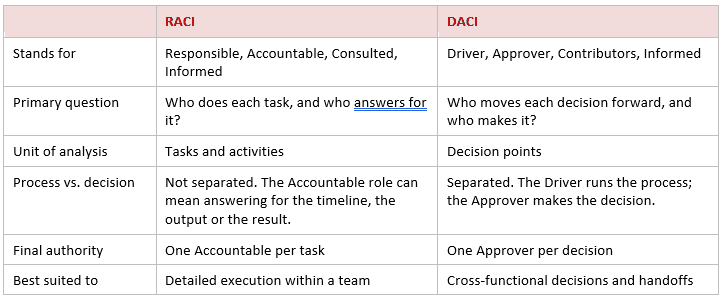
At the end of the day, it takes both. Within a specific team, where there is almost a production-line style of work, a RACI can work quite well. So look at those teams and determine:
- Does this follow an assembly-line model?
- Can accountability be cleanly handed off between steps?
- Does introducing this model cause argument?
If your answers are yes/yes/no, then RACI is a good fit for that team.
But at the high level, when you get your head of creative, web, brand, demand gen, campaigns, or whoever else together to talk about a workflow, then DACI is likely the best option. In those cases, you need to avoid teams blaming each other. Strong, but separate, ownership of project driving and approvals is important. Clear escalation and resolution pathways is key.
If you want to talk more about this, I am always game. Acceleration@heinzmarketing.com.