How to Start Using AI Agents Without Rebuilding Your Org Chart
 Payal Parikh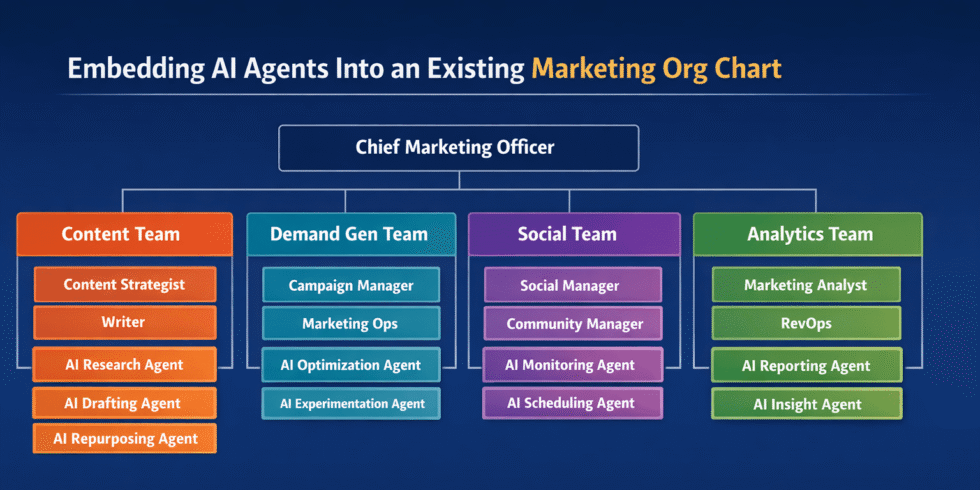
Summary
This post explores how CMOs can begin integrating AI agents into their existing marketing organization without needing to redesign their org chart. It outlines how AI can be embedded into current workflows across content, demand generation, social, and analytics, to reduce operational drag and increase team efficiency. By starting with high-volume tasks and gradually increasing autonomy, marketing leaders can build confidence in AI while laying the groundwork for a future AI-enhanced organization.
Table of Contents:
1. Why Most CMOs Can’t Redesign Their Org Chart Yet
2. Start With the Org You Already Have
3. Designing Agents Around Workflows
4. The Three Stages of AI Autonomy
5. Introducing AI Without Breaking Governance
6. What CMOs Should Measure First
7. From Embedded Agents to an AI-Enhanced Organization
Over the past year, the conversation around AI in marketing has shifted from tools to systems. Instead of asking which AI applications to adopt, many organizations are beginning to explore AI agents that can perform tasks, learn from data, and operate autonomously within defined guardrails.
In a previous post, I wrote about what an AI-enhanced marketing organization might look like, mapping AI agents to core roles like content, demand generation, social media, and analytics.
But most CMOs aren’t redesigning their org chart tomorrow. Budgets are set, reporting structures are in place, and teams are already operating at capacity.
The reality for most marketing leaders is this: a need to begin adopting AI within the organization you already have.
Developing AI agents to fit your existing org chart allows teams to experiment, build internal confidence, and demonstrate real operational lift before making larger structural changes.
Why Most CMOs Can’t Redesign Their Org Chart Yet
Even when leaders recognize the potential of AI, redesigning roles and reporting lines can take a long time.
There are some practical constraints:
- Headcount plans are tied to annual budgets
- Teams are already operating at capacity
- Changing reporting structures introduces disruption
- Leadership wants proof of impact before committing to transformation
Because of this, the most successful organizations are starting with operational integration. A key question to ask is “Where inside our existing workflows could AI agents remove operational drag?”
Start With the Org You Already Have
Let’s start with these core functions in the marketing org: content, demand generation, social media, and analytics. These functions already contain repeatable workflows where AI agents can create immediate value.
The goal isn’t to replace roles. It’s to augment the work those roles perform every day.
For example, a content strategist’s responsibilities typically include research, editorial planning, drafting, editing, and distribution. An AI agent doesn’t need to own the entire role to be useful. Instead, it can plug into specific steps within that workflow.
An AI research agent can gather competitive insights and keyword opportunities before a campaign begins. A drafting agent can generate a first pass of a blog post or landing page. A repurposing agent can automatically transform a long-form piece into social posts or email snippets.
The strategist still owns the narrative, positioning, and final output. But the operational burden is dramatically reduced.
This same pattern appears across other marketing functions.
Demand generation teams often spend significant time monitoring campaign performance, identifying optimization opportunities, and testing variations. AI agents can assist by continuously analyzing campaign data, recommending experiments, and even adjusting budgets within predefined thresholds.
Analytics teams, meanwhile, often spend hours assembling reports that executives read for a few minutes. AI agents can automatically generate dashboards, summarize performance insights, and flag anomalies before human analysts begin their review.
In each case, the AI agent fits inside the existing structure, supporting the role rather than redefining it. That way, humans can do more strategic tasks, focus on QAing the work done by agents and be a gatekeeper before the work gets published or finalized.
Designing Agents Around Workflows
Design AI agents around specific stages of work. Consider a simplified content workflow:
- Research and topic discovery
- Brief creation
- Draft writing
- Editing and optimization
- Distribution and promotion
Each stage presents a clear opportunity for automation or assistance. Instead of assigning one large AI system to the entire content team, organizations can deploy smaller, specialized agents to support individual steps.
This modular approach has several advantages. It allows teams to introduce automation gradually, maintain clear human oversight, and experiment without disrupting existing processes.
Most importantly, it helps employees see AI as a collaborator rather than a replacement.
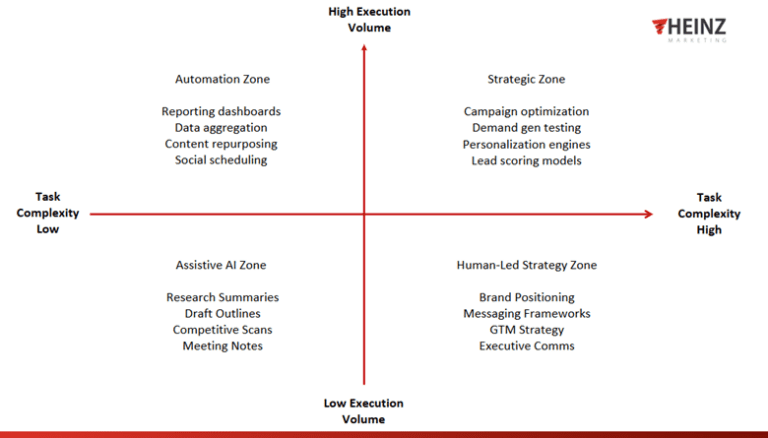
Here’s an example of how we are using AI agents in our organization.

At Heinz Marketing, we’ve developed an internal library of AI agents designed to support specific marketing workflows from research and content generation to campaign development and optimization.
The Three Stages of AI Autonomy
Not every agent should operate at the same level of autonomy. In most marketing organizations, AI adoption progresses through three stages.
The first stage is assistive. At this level, AI agents generate recommendations, insights, or drafts that humans review and refine. Many teams begin here because it introduces minimal risk while providing immediate productivity gains.
The second stage is collaboration. AI agents perform larger portions of work like generating full drafts, preparing reports, or suggesting campaign optimizations. But human approval steps are still required before actions are finalized.
The third stage is controlled autonomy. Here, agents execute certain tasks automatically within clearly defined guardrails. Examples might include adjusting paid media bids within a fixed range, generating routine reports, or scheduling social content.
Moving too quickly can introduce risk. Moving too slowly can limit impact. To be most effective, you can adjust autonomy gradually.
Introducing AI Without Breaking Governance
As AI agents become more integrated into daily operations, governance becomes an important part of the conversation. Like who is accountable for each AI agent output.
- Who reviews AI-generated content?
- What actions can agents take without approval?
- Which data sources are they allowed to access?
Addressing these questions early helps organizations avoid confusion later.
Governance doesn’t require heavy bureaucracy. In most cases, it simply means defining clear guardrails. For example, organizations may require human review for any customer-facing content while allowing automated reporting or campaign monitoring to operate independently.
Establishing these boundaries will build trust internally and ensure AI systems operate responsibly.
What CMOs Should Measure First
When introducing AI agents, success should not be measured only by output volume.
The real value often appears in operational efficiency and strategic capacity.
CMOs should pay close attention to metrics such as reduced campaign cycle time, faster content production, improved experimentation velocity, and the amount of time teams spend on strategic work instead of manual tasks.
These indicators often reveal the true impact of AI integration long before revenue attribution becomes clear. And these indicators will create buy-in on AI investments from the CEO and leadership team as well.
From Embedded Agents to an AI-Enhanced Organization
Embedding AI agents into an existing org chart is the first step toward a much larger transformation. Certain workflows become highly automated. Others remain deeply human-driven. New roles may emerge around AI orchestration, performance monitoring, and governance. Over time, these changes naturally reshape the structure of the organization.
For most CMOs, the smartest path forward is to start with the workflows that already exist, introduce AI where it removes the most friction, and allow the organization to evolve from there.
| Stage | What Happens | Example |
| Workflow Support | AI assists specific tasks | Draft writing, reporting |
| Role Augmentation | AI supports entire roles | Campaign monitoring |
| Operational Integration | AI becomes embedded in workflows | Automated optimization |
| Structural Evolution | Org chart evolves | AI-enhanced teams |
The future marketing organization will almost certainly be hybrid. Combining human creativity with AI-powered execution.
If you’re exploring how AI agents could fit into your current marketing organization, our team at Heinz Marketing has been developing and testing these systems internally. We’re happy to share what we’ve learned. Email us at acceleration@heinzmarketing.com.