Your Scoring Model Only Knows One Kind of Buyer
 Matt Heinz
Summary
There are three, and the plays that work on one go against you in the others — three proven playbooks and five AI prompts below. Most B2B scoring models conflate three different signal types (evidence, need, and intent) into one score, and shows how to route each to the right owner, speed, and play — plus five ready-to-use AI prompts for classifying and acting on signals.
Most scoring models in B2B are measuring the wrong thing.
Just because someone clicked on your website a number of times doesn’t make them qualified. Just because they attended your last three webinars doesn’t mean they’re sales ready. It could mean they’re bored.
We equate activity with intent, and that is not always accurate. Somebody filled out a form, attended a webinar, stopped by the booth. Sure, that’s a reason to follow up. It’s also an inaccurate and incomplete way of thinking about what a signal actually tells you.
Everyone has the signals now
We’ve gotten to the point where signals are kind of like contact information. It’s everywhere. It’s no longer a moat to say you have a list of everyone in your industry, and it’s no longer a moat to say you’ve got intent signals, because whoever’s selling them is selling them everywhere. AI can find them all over the place.
I can’t tell you how many times I’ve heard from marketing leaders who say some version of the same thing: I gave these signals to my sales team and they don’t know what to do with them.
That’s not a sales failure. Sales teams are trained to respond to a download, a demo request, an inbound question. If you tell a rep that someone experienced something yesterday, there’s nothing in the standard playbook that tells them what to do with that.
The research shows how wide the gap runs. Gartner found that marketing and sales teams collaborate on just three of fifteen commercial activities, and that 60 percent of the leaders they surveyed report a lack of shared buyer journey insights. In Demand Gen Report’s benchmark survey recently, about one in five respondents said they have an intent data strategy that’s actually being executed and measured. Forrester’s intent data research has found that companies using intent data do get benefits, but fewer than they expected across every category surveyed, with the largest shortfalls in sales use cases.
More companies expected benefits than achieved them.
Gartner also found that 73 percent of B2B buyers actively avoid suppliers who send irrelevant outreach. A signal fired into a form-fill playbook produces exactly that kind of outreach, which means bad activation costs you the account.
What this looks like when it goes wrong
Someone at a target account downloads your compliance guide, comes back for it twice more, then shows up at two webinars. Your model gives them eighty points. They cross the threshold, they become an MQL and a BDR calls to ask about timeline and budget.
Here’s what was actually happening. A regulation changed in their industry, their VP asked them to write an internal recommendation, and they’re three weeks into figuring out what the problem even is. No budget. No project. No mandate to buy anything.
The scoring model saw intent. What existed was a person doing homework on a problem they’d just been handed. The call for that moment was helping them write the recommendation, and instead they got asked when they’re planning to purchase.
Three kinds of signals
Simply using the phrase “intent signal” implies the prospect has intent. Most people hear that as intent to buy. Not necessarily.
Here’s the split that works for the companies I see getting real value out of this.
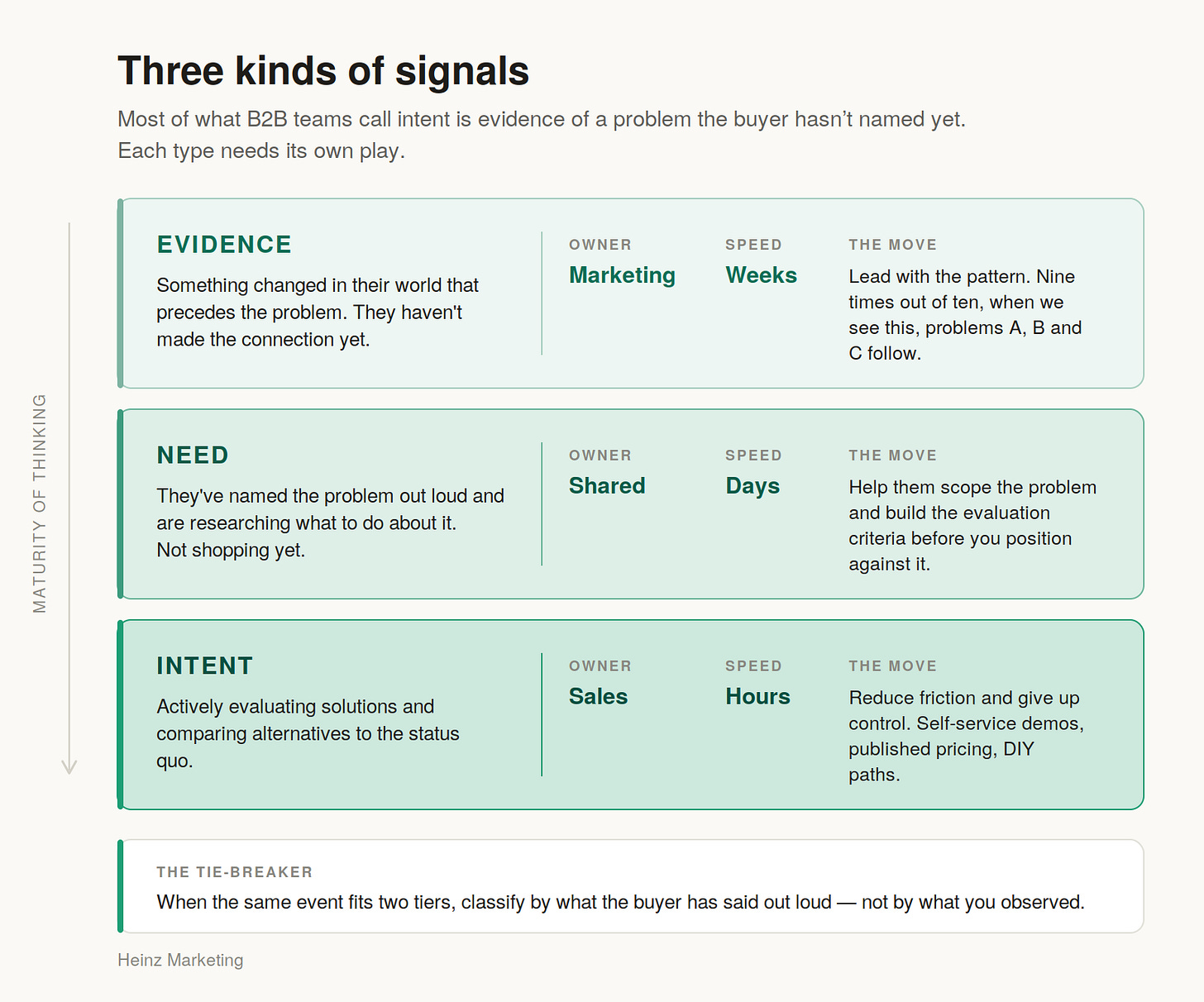
Intent signals. The prospect has shown specific interest in solutions and is actively exploring alternatives to the status quo. Pricing pages. Comparison content. Competitor evaluation. A demo request.
Need signals. The prospect has expressed or exhibited, directly or indirectly, that there’s a known problem and they’re researching what to do about it. They’ve named the pain. They haven’t started shopping. A job posting that spells out the problem in the requirements. Someone asking peers in a community how they handle it. Category-level research on a review site.
Evidence signals. Signals of a problem that you know are pre-need and pre-intent, but the prospect hasn’t made that translation yet. A funding round that changes what the team is accountable for. A leadership change. A regulatory shift. An acquisition that just doubled the complexity of their stack. A competitor’s security breach.
When the same event seems to fit two tiers, the tier is set by what the buyer has said out loud rather than by what you observed. A job post that names the pain in the requirements is need, because they wrote it down. A hiring spike you inferred the pain from is evidence, because they haven’t. Same company, same week, different play.
That third category is the one almost everybody still wastes.
Think about a cybersecurity buyer. If there’s a breach at a prospect’s competitor, that’s one of those “we should have had earthquake insurance” moments. The signal has nothing to do with your brand. Nobody filled out anything. And it has changed how that company prioritizes a problem more than any webinar you’ll ever run.
Because you know their issues, because you’ve seen this movie before, you can translate evidence into need in a way the prospect can’t yet do for themselves. No signal vendor can sell you that translation.
The playbooks
Evidence signals
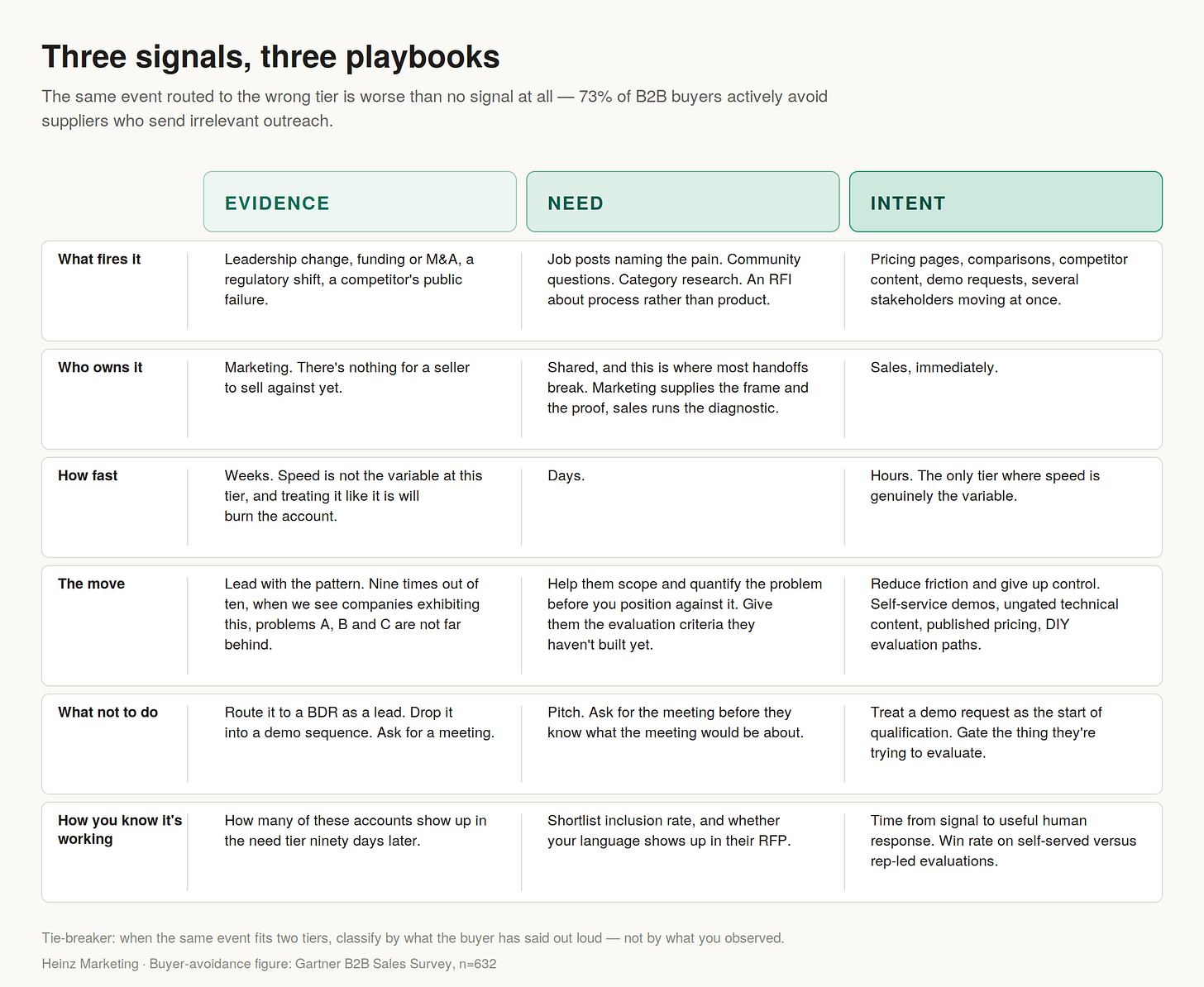
What fires it: A change in the account’s world that correlates with a problem they haven’t named. Leadership changes, funding events, tech stack moves, regulation, M&A, a peer or competitor’s public failure.
Who owns it: Marketing. The buyer doesn’t know they have a problem, which means there’s nothing for a seller to sell against yet.
How fast: Weeks. Speed is not the variable at this tier, and treating it like it is will burn the account.
The move: Lead with the pattern. “Nine times out of ten, when we see companies exhibiting this, this and this, problems A, B and C are not far behind. Many companies in your position have gotten ahead of it. Want to see how?” And the playbook you’re offering just happens to be embedded in what you sell.
What not to do: Route it to a BDR as a lead. Drop it into a demo sequence. Ask for a meeting. All three tell the buyer you weren’t paying attention.
How you know it’s working: Reply rates on insight-led outreach, and how many of these accounts show up in the need tier ninety days later. That second number is the real one.
Need signals
What fires it: The prospect has named the problem and is researching what to do about it. Job posts describing the pain in the requirements. Community questions. Category-level research. An RFI about process rather than product.
Who owns it: Shared, and this is where most handoffs break. Marketing supplies the frame and the proof while sales runs the diagnostic conversation.
How fast: Days.
The move: Help them scope and quantify the problem before you position against it. Give them the evaluation criteria they haven’t built yet: what to measure, what to ask vendors, where the hidden costs are, what a good outcome looks like in twelve months.
Buyers form their shortlist early. 6sense, which sells intent data and has a stake in the answer, found that buyers fill about three and a half of four shortlist slots on day one and pick from that day-one shortlist 95 percent of the time. Whoever helps frame the criteria tends to be on it.
What not to do: Pitch. Ask for the meeting before they know what the meeting would be about. Send a case study about a problem they’ve defined differently than you have.
How you know it’s working: Shortlist inclusion rate, and whether your language shows up in their RFP.
Intent signals
What fires it: Active evaluation. Pricing, comparisons, competitor content, demo requests and multiple stakeholders at one account moving at once.
Who owns it: Sales, immediately.
How fast: Hours. This is the only tier where speed is genuinely the variable.
The move: Reduce friction and give up control. Self-service demos, ungated technical content, published pricing, DIY evaluation paths. Giving control to the buyer increases engagement, and it gives your salespeople their time back for the prospects who genuinely want to talk to someone.
What not to do: Treat a demo request as the start of qualification. Make them wait two weeks for a calendar slot. Gate the thing they’re trying to evaluate.
How you know it’s working: Time from signal to useful human response, and win rate on self-served evaluations versus rep-led ones. If the self-served ones win more, you’ve learned something.
The triage layer
Three things govern all three playbooks.
Look at the account, not just the person. If you see activity surging from four or five members of the same team at one company, something happened. People came out of a meeting or an all hands and suddenly they’re hot to trot on something. Person-level scoring can’t see that.
There’s a cost to getting this backwards. Gartner found that content focused on individual-level relevance can create conflict inside the buying group, with a 59 percent negative impact on consensus, while buying-group relevance made buyers three times more likely to report a high-quality deal. Personalizing hard to one person can actively cost you the group.
Triage, or you’ll just build a new lead-volume problem. This becomes a situation where we flood the sales team with signals, and not all of them are worth working. Know which signals imply the greatest maturity in the prospect’s thinking, and route accordingly. A volume based approach didn’t work for leads and it won’t work for signals either.
Assume everything expires. Our team has found that most B2B intent signals go stale within 30 to 45 days, and that traditional scoring models degrade a couple of percentage points every month nobody maintains them. Some of these signals are static, many are dynamic, which means you can’t just build the list and let it ride.
Workflows you can build without buying anything
The classification and drafting work here is exactly what LLMs are good at, and you can stand these up with whatever you’re already using.
Two rules before you build any of them. Ground the model in your own material (your ICP, your win/loss notes, your actual closed-won patterns) because a model reasoning from general B2B knowledge will give you general B2B answers. And keep a human in the loop on anything that reaches a buyer. I never let AI send outreach without reviewing it.
1. The classifier
Run this against the last twenty signals your team acted on. The output is usually uncomfortable.
You are helping me classify go-to-market signals for [COMPANY], which sells
[WHAT YOU SELL] to [ICP DESCRIPTION].

We classify every signal into one of three tiers:

- INTENT: the account is actively evaluating solutions and comparing
alternatives to the status quo.
- NEED: the account has named a problem out loud and is researching what to
do about it, but is not yet evaluating vendors.
- EVIDENCE: something changed in the account's world that we know precedes
this problem, but the account has not made that connection yet.

Tie-breaker: if the same event could fit two tiers, classify by what the buyer
has stated explicitly, not by what we observed or inferred.

Here is the signal:
[PASTE THE SIGNAL - what happened, who, what account, when, source]

Return:
1. The tier, and your confidence (high/medium/low)
2. The specific reasoning, citing what in the signal drove the call
3. What would have to also be true for this to be one tier higher
4. The single worst thing we could do in response
5. A one-sentence recommended next action, with an owner and a timeframe

If the signal is ambiguous, say so and classify it DOWN a tier rather than up.
Over-classifying is the more expensive error.
That last instruction matters more than anything else in the prompt. Scoring systems default to optimism.
2. The queue ranker
The daily job is deciding which forty of these are worth anyone’s Tuesday.
Here is this week's signal queue for [COMPANY]:
[PASTE: account, contact, role, what happened, when, source, tier if known]

Rank this queue by maturity of the prospect's thinking - how close the account
is to being able to make a decision - not by recency and not by volume of
activity.

For each item return:
1. Rank, tier and a one-line rationale
2. Owner (marketing, BDR, AE) and the window it should be worked in
3. Whether other signals in this same queue are from the SAME account. Group
those and tell me whether the cluster changes the ranking.

Then give me a "do not work this" pile: everything that looks urgent but
isn't, with the reason it's a false positive.

Finally, name what's missing. What signal would you expect to see for these
accounts that isn't in this list, and what does its absence tell us?
That last question surfaces the gaps in your data rather than the gaps in your follow-up.
3. Evidence tier — the insight builder
Run this in a model with web search turned on, and check every source link before you use anything.
Research [ACCOUNT NAME] and identify EVIDENCE-tier signals: changes in their
business that historically precede the problems we solve, but that they likely
have not connected to those problems yet.

Look for: leadership changes, funding or M&A activity, hiring patterns that
imply a capability gap, technology or vendor changes, regulatory exposure,
public incidents at close competitors, and shifts in their published strategy
or investor communications.

Our context:
- We solve: [PROBLEMS]
- What a bad month of this problem costs a company their size: [YOUR NUMBER]
- The pattern we've seen repeatedly: [DESCRIBE 2-3 REAL EXAMPLES FROM YOUR
OWN CLOSED-WON DEALS - what was happening at the account 6-12 months before
they bought]

For each evidence signal you find, give me:
1. What changed, with a source link and date
2. The problem it likely creates in 2-6 months, and why
3. Who in the org feels it first
4. A three-sentence note to that person that shares the pattern and offers
the playbook, with no ask, no meeting request and no product mention

Flag anything you inferred rather than sourced. If you cannot find a source
for something, leave it out rather than describing it.
4. Need tier — the criteria builder
[ACCOUNT/PERSON] has signaled they have this problem: [DESCRIBE THE NEED
SIGNAL AND WHERE IT CAME FROM].

They have not started evaluating vendors. Help me help them think.

Build a vendor-neutral evaluation framework for this problem:
1. The 5-7 questions they should be able to answer before they talk to
anyone
2. The costs of this problem companies typically miss when they scope it
3. What "solved" looks like at 3 months, 12 months and 24 months
4. The 3 questions that best separate real solutions from demos that look good
5. Where a company like theirs - [SIZE, INDUSTRY, STAGE] - usually gets this
wrong

Write it so it would still be useful to them if they never bought from us.
Do not mention our product. If our approach loses on any of these criteria,
tell me which and why.
Leave that last line in. If your solution can’t survive an honest criteria list, you want to know that before the RFP does.
5. Intent tier — the account surge check
Here is the recent signal activity for [ACCOUNT] across our systems:
[PASTE: contacts, roles, actions, dates, sources]

Analyze this as a buying group rather than a set of individuals:

1. Is this a coordinated surge or unrelated individual activity? What's the
evidence either way?
2. If it's a surge, what internal event most likely triggered it?
3. Map the roles engaging to the buying group we'd expect for a purchase like
this. Who is missing?
4. Based on what each person has actually done here - not on role stereotypes
- what does each appear to be optimizing for, and where would those
priorities conflict? Say "not enough data" where that's true.
5. Give me one message for the group's shared decision, plus what each
individual needs to hear to be comfortable saying yes.
6. Tell me what would make you wrong about all of this.

Note explicitly where you're inferring versus reading the data.
Ask any model to argue against its own take. The answers get noticeably better, and you find the deals that were never as warm as the dashboard suggested.
Why most teams still don’t do this
This is not easy. It’s also not rocket science. There’s a clear playbook, plenty of companies have already walked it and you can do it in phases.
But it’s worth being honest that adopting this is a culture change rather than a campaign change. You’re asking a sales team to act on something that isn’t a lead, asking marketing to own a customer knowledge base rather than a lead number and asking both to agree on what a signal means before it fires rather than arguing about it after.
Complexity is a law of physics in B2B buying and selling.
Start with the last twenty signals your team acted on and classify them. My guess is that most of what you called intent was evidence, and that you responded to almost all of it the same way.
This post originally appeared on Matt Heinz’s Substack.