Improving Accountability in Marketing Teams
 Tom Swanson

By: Tom Swanson, Senior Engagement Manager at Heinz Marketing
“There is no accountability” is the single most common complaint I hear when working with teams struggling with structure. Most of the time, I agree. When something goes wrong in the workflow, it is often unclear where the break was, exactly. Creative blames review timelines, reviewers blame the strategy being unclear, strategists blame the tactical teams, and on it goes.
If you want to get more familiar with Marketing Orchestration.
Accountability is a squishy term, we should nail it down before we go any further. To me, it means: the person/team that owns the key decisions and results of an effort. The important thing to note here is that accountability comes with decision power.
When I talk to teams, they tend to use accountability to mean “who is blamed when things go wrong”. The decision-making gets lost, and so does the credit, so accountability becomes a purely negative thing. Nobody wants more accountability when the real implications of that is more stress, pressure, and risk. Where is the upside?
What winds up happening is a game of “hot-potato” where teams shift accountability as often as possible. Under this model, when it breaks, whoever is holding the potato of accountability is blamed for all of the issues, regardless of the mismanaged processes.
So here is my main argument today: project-level accountability should change hands as few times as possible in the lifecycle of a project.
Start with the project RACI
You could start with a DACI too. I have some thoughts on the matter (1, 2). 2 specifically focuses on accountability. Very relevant. Short version is that I find DACI to be a bit more compelling, but RACI is more defined/widely understood.
The first place to look is how accountability is assigned throughout a project lifecycle. The rules for a RACI are very clear: there can only be one accountable party. You can have lots of responsibles, consulteds, and informeds, but only one accountable.
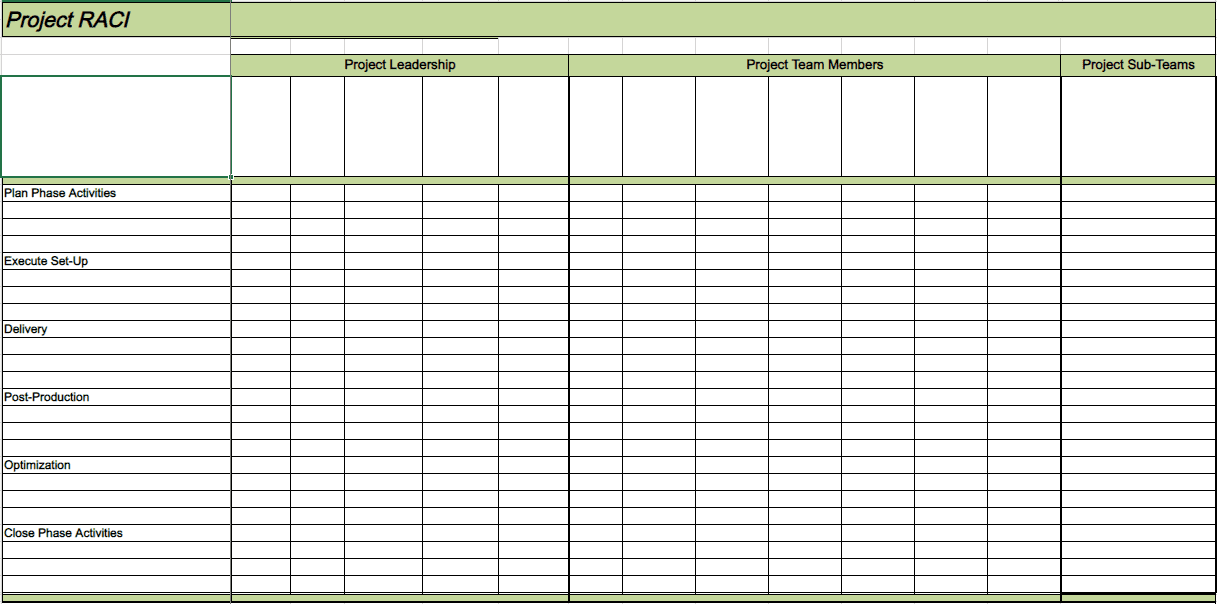
So mapping out your RACI matters, but what you are looking for is where accountability changes. You are looking for a few key things:
- How many times throughout the course of a project is accountability handed-off?
- How are those hand-offs structured?
- Is the receiving party aware that they are now accountable?
- Do they know/accept what that means?
For each of these hand-offs, go talk to the receiving team and see how comfortable they are being accountable there. What are their concerns? What decisions happen earlier in the flow that impact their ability to accept accountability? Who do they tend to blame when things go wrong?
The short of it is that most teams look at a RACI as a bunch of points-in-time, rather than holistically as a project. In a traditional workflow and RACI, there really is one solid way to improve this.
Limit hand-offs
When a hand-off occurs, it implies a transfer of accountability for the project. It has changed hands from one team to another, and now the receiving team is accountable for the project.
Every time this transfer occurs, it weakens the ability of the team to hold accountability. It becomes more difficult to isolate the specific cause of an issue when the project has changed hands many times. Each team has valid reasons to blame the others, and the result is that nothing ever changes and the same mistakes occur over and over.

This is not a real workflow, but ChatGPT did a great job at indicating how many marketing teams approach accountability.
Hand-offs need to be reduced. This doesn’t mean new teams can’t come in regularly, but the ownership of the project needs to be consistent. There needs to be one hand driving the project forward, making sure deadlines get hit (or documented with reasons if there are unavoidable delays), and ensuring the outputs match the strategy. One person, consistent throughout the project, would be ideal.
This is a big job, though, so how do you go from distributed accountability (read: none) to consolidated and enforceable?
Balance power and risk
Accountability is a risk, plain and simple. If you are on the hook for results of a campaign, then there is a risk that things go bad and you are held accountable. As good business-people, we often think about how you balance risk and reward. Maybe you can pay your way out of this to have someone hold the risk, but the real thing that makes the risk acceptable is the decision power.
Whoever is accountable to the results of a project should have ultimate decision-power in that project.
This is a simple rule, but it makes teams pretty uncomfortable. As an example, let’s say that accountability for a project is owned by the campaign manager. If there are disagreements between creatives and the campaign manager, giving the manager decision rights means they get to decide what gets published. If the creatives don’t want to put their stamp on it, how is that handled?
In the above example, the campaign manager would be able to override the creative team. Ideally, they would listen and collaborate, but at the end of the day someone needs to say “good enough, let’s get to market”. That should be the accountable person. If the creative fails, the campaign manager has to answer because they own the project and decided this was good enough.
Within this model, the campaign manager would own all of those decisions, for better or worse, but other teams have accountability too. Creative teams are still accountable to their own internal processes, quality guidelines, and management. The same goes for any of the other teams that contribute along the way.
The short of it is this: with great power comes great responsibility.
Know your escalation
The above example also brings up one other point I will leave you with: escalation needs to be clear. If the creative team and the campaign manager disagree and cannot move ahead, there needs to be clear escalation. When two teams come to an impasse, or a responsible team has a fundamental disagreement with the accountable team, who hears about it?
The power that comes with accountability is checked in this way. If you start to see frequent issues getting escalated, that is worth examining. Why is that occurring? Is it an individual problem or a structural one? What happens when these folks get in the same room with an exec mediator?
All of this is just good project workflow design, and something I recommend you look at in your team. Marketing is notoriously messy and difficult to track, but projects don’t have to be.
Come talk with us if you are curious to get your marketing orchestration in order. Or, take our free marketing orchestration self-audit for a readout with some concrete next steps.