One Team + Multiple Operating Models = Compounding Drag
 Matt Heinz
Summary
What leadership team gaps reveal about how marketing work really gets done (and why everyone's go-to fix makes things worse). When leaders on the same team score their own operation, their answers cluster into two groups, not one, because two different operating models are running side by side. The fix isn't a better intake form; it's understanding how the work actually moves before you touch process.
A product launch comes apart because an executive objects to a key element late in the process.
That should just create a bad afternoon.
Instead, it takes the whole launch down because the one person holding the full plan is out of the country. Nobody else can produce the complete sequence, the asset list or who owns which step. The plan exists, everyone has seen it in meetings, but no one actually knows where it’s saved. The only person who seemingly knows is on a beach somewhere.
Variations of this story are incredibly common (and may very well sound familiar as you read this).
We launched a marketing orchestration self-assessment tool a few weeks ago and it’s been fascinating to watch not just CMOs but whole marketing leadership teams complete it.
A common occurrence once their assessment scores are compared to each other: leaders on the same team complete the assessment independently and their scores (on strategic alignment & planning for example) land more than two points apart on a five-point scale.
Same company. Same operation.
The composite comes out somewhere in the middle, which is a perfectly reasonable number that describes almost nobody’s experience of working there.
Averages hide what’s really happening
The instinct with any assessment like this is to report the composite and move on. It’s clean, it benchmarks well and it gives leadership something to improve. It also averages away the findings that matter most.
For example, some leaders describe an organization with real planning muscle: a defined intake process, clear ways to handle unplanned requests and established mechanisms for adapting when priorities change.
Others describe an organization where a senior request can override existing priorities in the meeting and everyone scrambles to comply.
Both groups, again still part of the same marketing organization, are reporting accurately about the part of the company they can see.
Sort the responses by composite and there isn’t much of a gradient. They cluster into two groups: one experiencing a relatively mature operating model and another experiencing something far more reactive.
That’s two operating models running side by side inside one organization, with leadership assuming there’s one.
The leader you think is too negative may have the widest view
The leaders describing the widest slice of the operation tend to score it lowest. The ones accountable for smaller, tighter areas score it higher.
The pessimism is highly correlated to scope.
I’d argue this is one of the first things to look for when you run this exercise with your own team. Almost every leadership group has someone with a reputation for seeing problems everywhere. Before you discount that person, check how much of the operation they can see.
Sometimes the person who looks most negative is simply standing higher where the seams show better.
Why a high collaboration score should worry you
Collaboration and communication, ironically, often comes in as the strongest of the four dimensions, with relatively little disagreement among the leaders.
Everybody’s people are good and legitimately trying their best. SMEs show up, teams talk to each other and nobody describes a fundamental communication breakdown between peers.
That’s the finding that concerns me most.
In all too many companies, leaders describe reconstructing campaign status from Slack threads, meetings and memory, then confirming it with the owner before they’d report anything up.
The information existed. It just didn’t live anywhere reliable and took way too long to rebuild (and you know there were still discrepancies in that reconstruction).
But people still go and got it by hand, every time, and they are good enough at doing that that nothing visibly breaks.
That’s where a high collaboration score can hide real problems. Your team is absorbing the cost of infrastructure and process you don’t have, and they’re paying for it in attention. Attention is the one input that doesn’t scale when you add people. Every hire can make that tax bigger, not smaller.
Gartner has found that 84 percent of marketers experience high collaboration drag as cross-functional work gets more complex. When almost everybody is dragging, dragging starts to feel like the job.
Why everyone’s favorite fix is the wrong place to start
Nearly every company we talk to who has tried and failed to overcome collaboration drag surfaces some version of the same original strategy: build a better intake process, so a new request gets weighed against what’s already committed instead of decided live in the room.
It’s the right fix.
It’s also one that fails constantly because teams start in the wrong place.
Intake only works if you can answer, “What would have to move?”
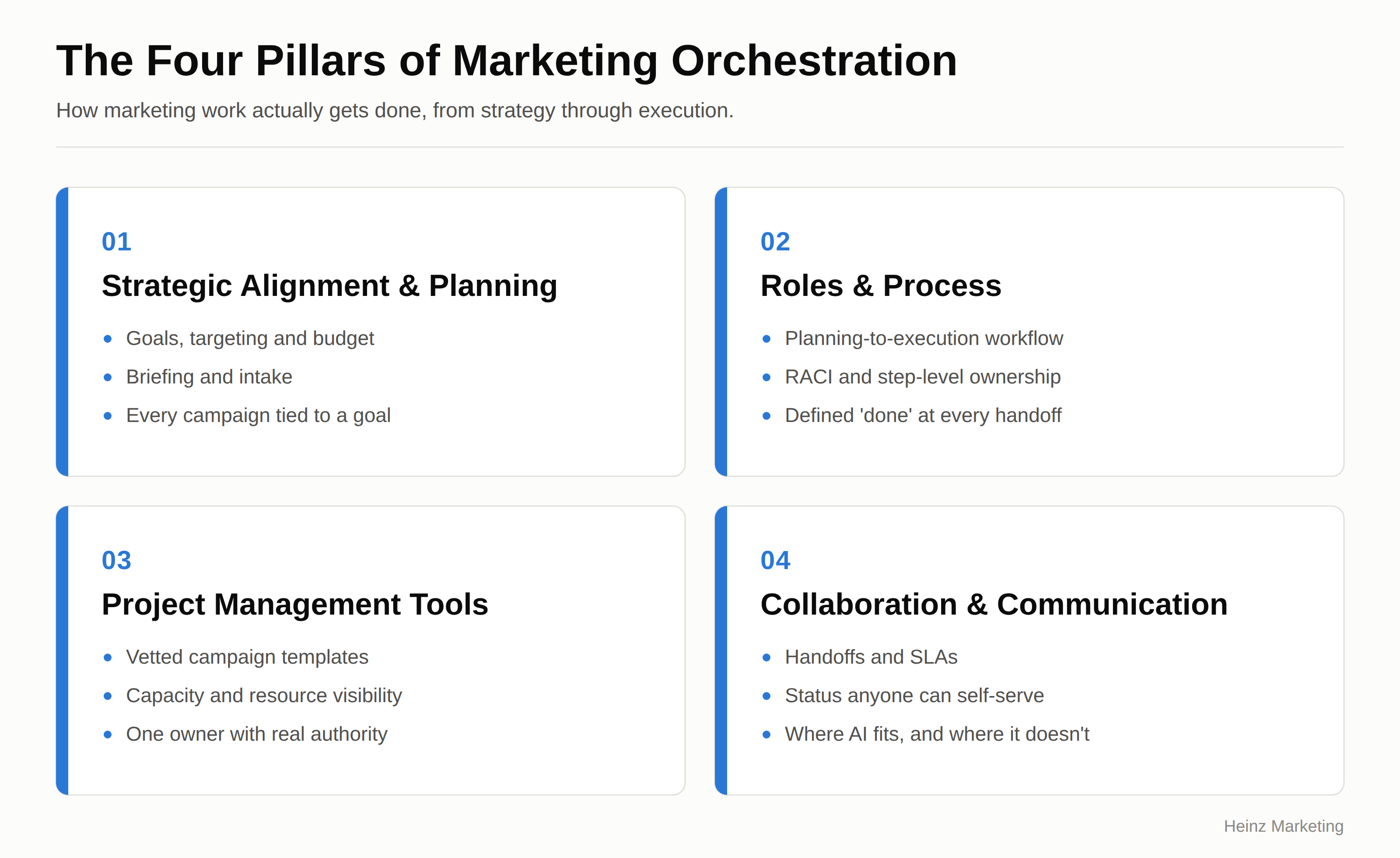
That requires knowing who’s loaded and what’s already in flight. Which requires some consistency in how work is structured and tracked. Which requires clear ownership below the team level.
Many leaders describe accountability sitting primarily at the team level, where everyone can honestly say they did their part while the work stalls in the gaps between them. Most also describe campaigns being built largely from scratch or heavily adapting whatever template exists.
So when intake goes first on the roadmap, it can’t answer the question it exists to answer, and within a quarter it’s already a form nobody fills out.
We’ve seen the same pattern in large marketing organizations that had already tried to fix their workflow more than once.
By that point, the process gap isn’t even the hardest problem. Change fatigue is.
What worked wasn’t starting with another tool or another intake form.
It started with understanding how work actually moved through the organization. Then documenting the planning-to-execution workflow and naming the communication points. Then clarifying ownership and mapping who touched what and when. Only after that did the team configure its project management platform around the workflow.
Centralized intake, the thing everybody wanted first, came much later.
They tested the new approach with a small group and a narrow type of work, met regularly to find what broke, fixed it and only then expanded it.
The impact sounds modest on paper and matters enormously in practice.
Capacity became something leaders could see instead of guess at. Requests started routing more consistently. Service levels became measurable. New teams could adopt the process without rebuilding it. Time to market improved, and so did morale, which is the outcome nobody puts in the business case and everybody feels.
You probably already have the answer
The thing that still gets me most across these assessments: nearly every gap named in the lower-scoring responses is already solved somewhere in the higher-scoring ones.
One group has campaign status available without having to ping a human. Another has a mature project management process with governance behind it. Another has clear expectations at each stage and has defined where AI belongs at the workflow level rather than leaving it to individual habit.
Best practices for almost every gap already exist inside the organization.
But nobody has the mandate to make one team’s good pattern everybody’s best practice.
That’s a very different problem than a capability gap, and usually a cheaper one to solve.
It also explains why it sits there. The work crosses teams, so it belongs to no single leader, and it loses its forcing function the first week something catches fire.
The way it gets unstuck is less clever than people expect: involve the people doing the work early, listen to where the process breaks and build the new approach with them rather than handing it down afterward.
The people doing the work already know where it breaks.
Try three of the questions on your own operation
These assessments work because the questions are scenarios rather than opinions. Each answer option reflects a level of operational maturity, so people pick the one that describes their actual week and the score falls out of that. Nobody has to rate themselves, which is why the answers tend to come back honest.
Three of them, roughly:
You need a campaign’s current status. What do you actually do? The options run from reconstructing it out of Slack threads and memory, to asking the people who would know, to reading it off a shared system in under a minute.
A senior leader asks for something mid-quarter that isn’t on the plan. What happens next? Somewhere between the decision getting made live in the meeting and the request getting scoped against what’s already committed, with the tradeoff named.
Your messaging shifts mid-quarter. How long before in-flight campaigns carry the new version? Days, weeks or never, while campaigns already in market keep running the old framing.
Use the assessment for clarity and consensus
You can access the ungated marketing orchestration self-audit tool here. I recommend having several of your leaders score the operation independently, then look at where they disagree before you look at what they averaged.
The gap between your most and least optimistic leader will tell you more about how your marketing organization really runs than the composite score ever will.
This post originally appeared on Matt Heinz’s Substack.