“The Aim of Marketing Is to Make Selling Superfluous”
 Matt Heinz

Summary
Peter Drucker set that standard more than fifty years ago. Most B2B marketing departments were built to do the opposite, and AI buyers are about to notice. Pricing, packaging and positioning sit outside marketing's job description at most companies, even as AI-assisted buyers quietly run that exact test before a seller ever gets a call.
Most B2B marketing departments today are designed to make selling more necessary.
Peter Drucker would not have been impressed.
In The Practice of Management (1954), Drucker argued that because the purpose of a business is to create a customer, every business has “two—and only these two—basic functions: marketing and innovation.” He also insisted marketing wasn’t a specialized department at all. To him it was the whole business, viewed from the customer’s side of the table.
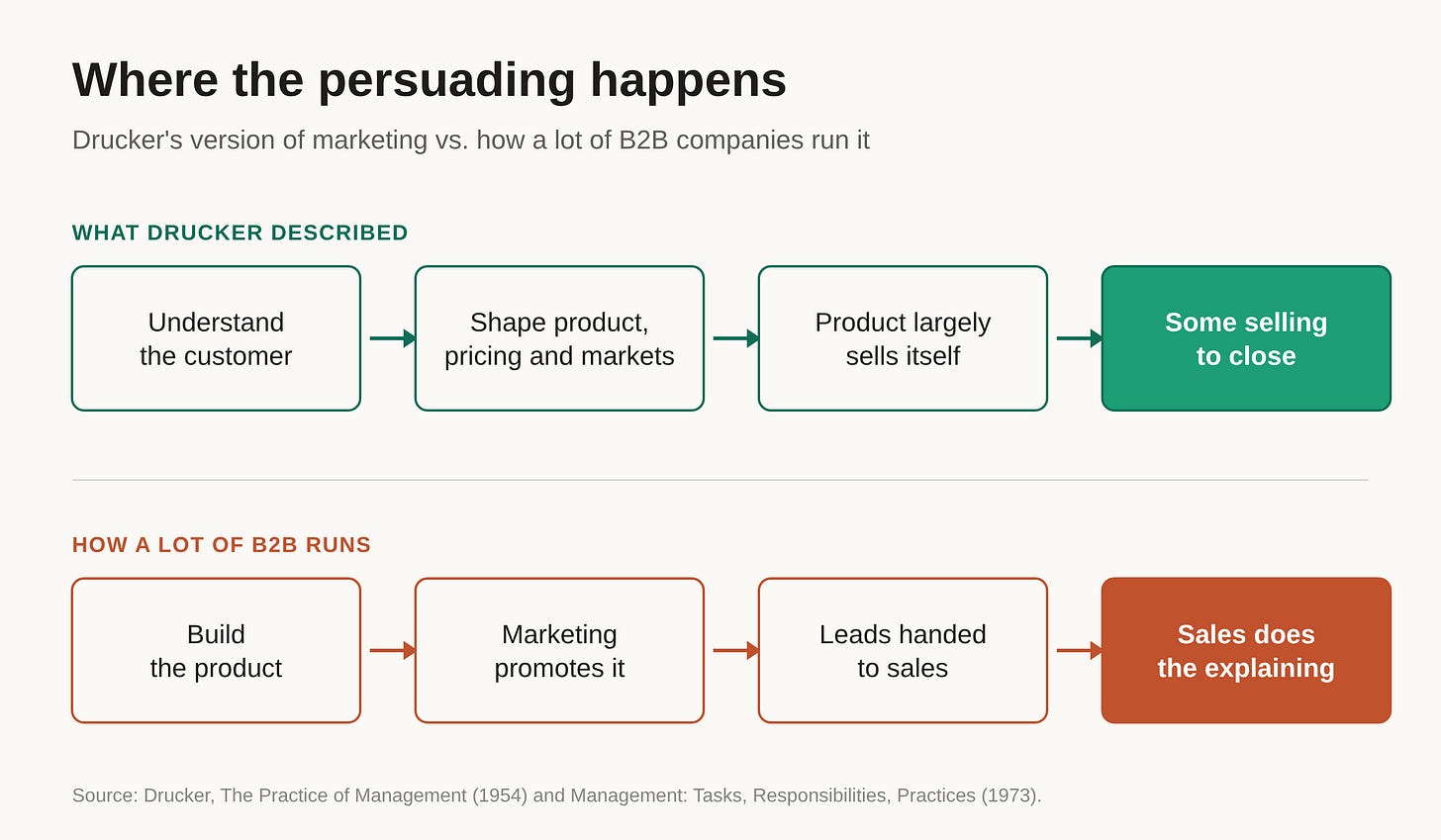
Two decades later, in Management: Tasks, Responsibilities, Practices, he sharpened it: “The aim of marketing is to make selling superfluous.” The idea is to understand customers so deeply that the product is an obvious fit and needs very little pushing.
He wasn’t anti-sales. In the same passage he conceded there will always be some need for selling. His argument was about where the persuading should happen, and how much of it the product and the market understanding behind it should already have done.
We own the megaphone
The CMO Survey (run out of Duke’s Fuqua School of Business with Deloitte and the AMA) asks marketing leaders every year what marketing is primarily responsible for in their company. Among the 161 B2B companies in the latest edition, the top of the list reads like a job description for a communications department:
- Brand: 94 percent
- Digital marketing: 92 percent
- Advertising: 84 percent
- Lead generation: 74 percent
Now the parts of the business Drucker would have called marketing:
- Pricing: 27 percent
- New products or services: 25 percent
- Innovation: 20 percent
- Market selection: 17 percent
And sales itself? 14 percent.
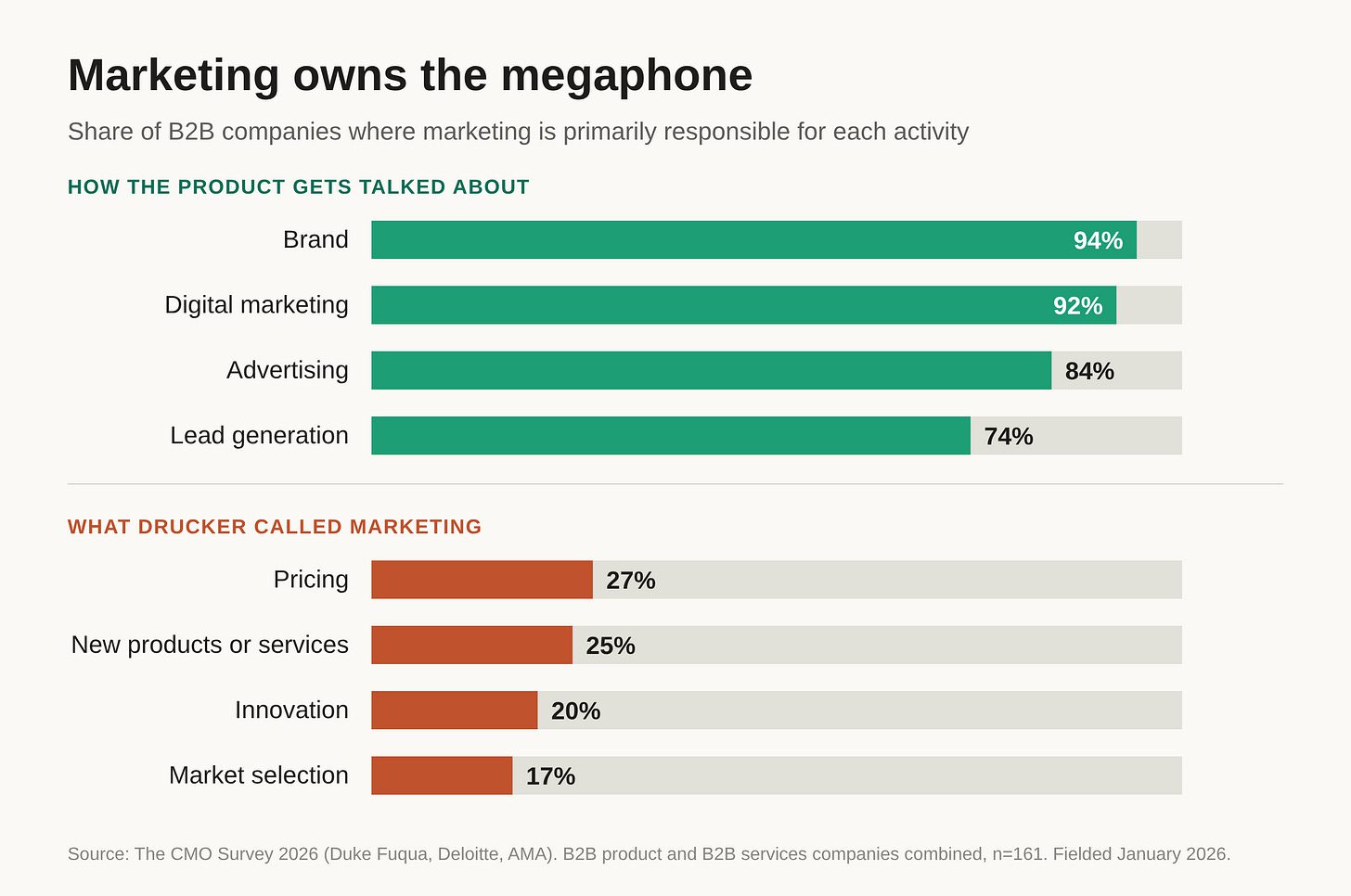
In other words, in roughly three out of four B2B companies marketing is in charge of how the product gets talked about, and isn’t primarily responsible for what gets built, what it costs or which markets to go after.
To be fair, Drucker never wanted marketing to be a department at all. He wanted the customer’s point of view running through every decision, whoever made it. I’d argue that makes the data more damning: we built the department anyway, gave it the megaphone, and in a lot of companies it’s not clear anyone owns the customer’s side of pricing and product (even with marketing’s scope growing across the full survey, including a 10-point jump in responsibility for revenue growth).
In a recent Gartner survey of 125 CEOs and CFOs, just 14 percent said their CMO is highly effective at market shaping, which Gartner defines as identifying and fulfilling unmet customer needs. That’s Drucker’s definition of marketing, nearly word for word. Six out of seven of the people who approve our budgets don’t think we’re doing it well.
None of this happened because marketers lacked ambition. A lot of us get measured on pipeline, so we (wait for it) build for and prioritize pipeline. Lead volume is easier to count than customer understanding, and the quarterly number (with the urgency it also brings) wins over more ambiguous market-building options almost every time.
But the result of that triage is a marketing function whose primary output is conversations for sales. Which means the product rarely got good enough at explaining itself, and sales kept doing the explaining.
Buyers have noticed. A Gartner survey found 73 percent actively avoid suppliers who send irrelevant outreach.
AI buyers are running Drucker’s test for us
More Gartner research found 67 percent prefer a rep-free buying experience. Forty-five percent had already used AI during a recent purchase. And 69 percent of buyers reported inconsistencies between what a supplier’s website said and what its sellers told them.
When a buyer (or increasingly, the buyer’s agent) builds a shortlist without talking to anyone, your product has to sell itself from whatever is public. Positioning, pricing, proof, comparisons, documentation. The buyer is running Drucker’s test whether we’ve prepared for it or not.
And look at that list again. Pricing, packaging and product fit for a specific segment are the exact responsibilities marketing doesn’t hold in most companies.
The old handoff model assumed a seller would fill in the gaps later. Fewer buyers are waiting around for that call. They’ll just ask the machine again (and it may well hand them your competitor’s pricing page instead).
The pushback is fair
“Superfluous” was always an overstatement, and Drucker’s own caveat admits it.
Complex, high-consideration purchases with a full buying committee still need somebody credible to pressure-test the decision. Gartner’s own research found buyers still prefer seller input when working out whether a solution fits their specific situation, and that confident buyers are twice as likely to report a high-quality deal.
So this then becomes an argument about where sellers spend their time. They should be focused on the part only a person can do, and marketing should own far more of what comes before it.
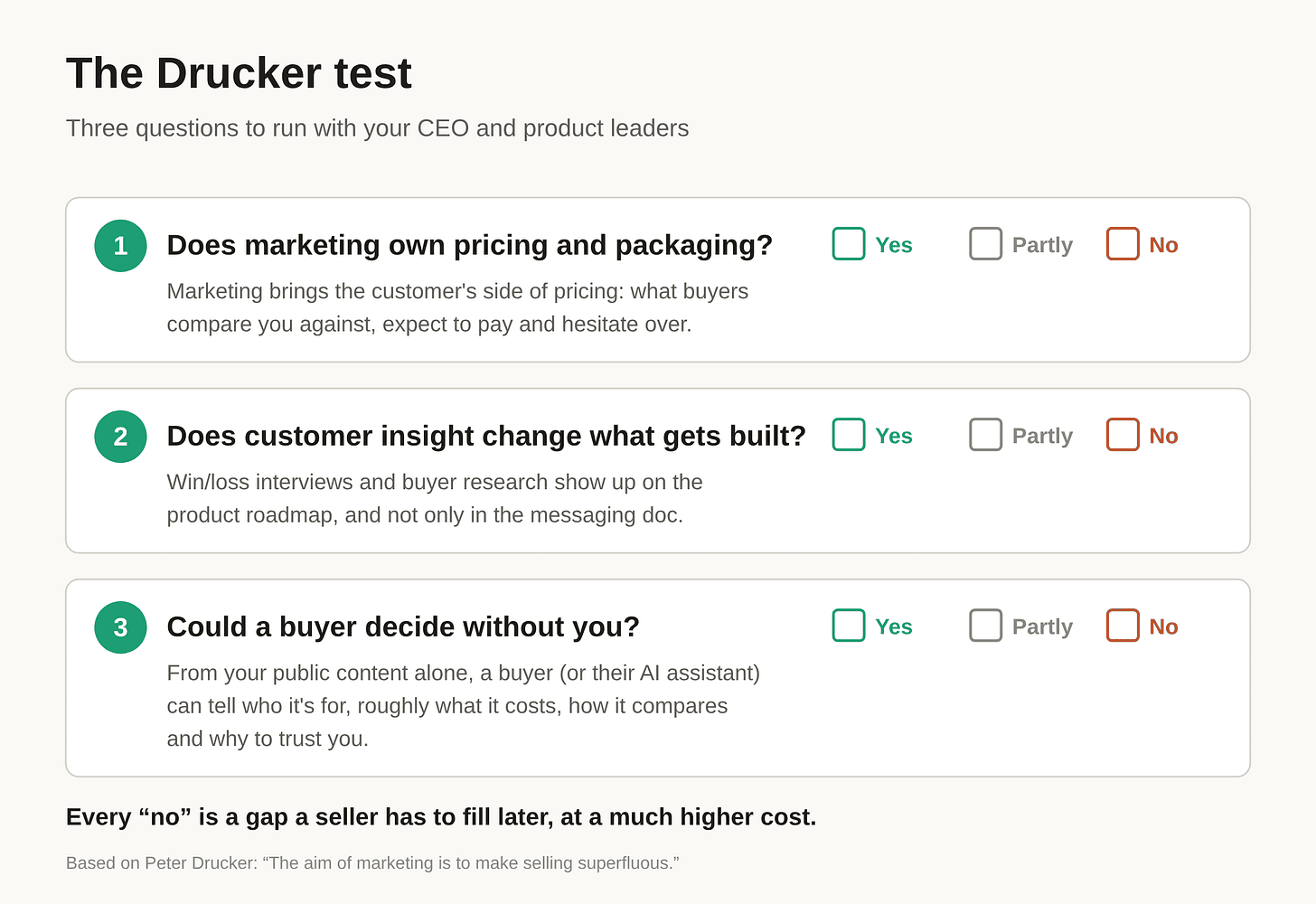
Three questions for your own Drucker test
Many marketing teams already have pieces of these conversations occasionally. I’ve come to believe they need to happen at least quarterly, with the CEO and product leaders in the room.
Does marketing own pricing and packaging?
If marketing has no seat in pricing decisions, you’re asking it to sell a value story it didn’t get to shape. You need to own the customer’s side of it: what buyers compare you against, what they expect to pay and what makes them hesitate.
Does customer insight change what gets built?
Win/loss interviews, buyer research and the patterns your sellers and community hear every week should show up on the product roadmap as well as in the messaging doc. If marketing learns something important about the customer and nothing changes upstream, marketing is functioning as a communications team.
Could a buyer decide without you?
Go through your own website as a skeptical buyer would (or better yet, ask an AI assistant to shortlist your category and see what it says about you). Can they tell who it’s for, roughly what it costs, how it compares and why to trust you? Every gap is one a seller has to fill later, at a much higher cost.
Drucker set that standard more than fifty years ago. Is it going to take buyers with AI assistants to start enforcing it?
Let’s make sure marketing gets there first.
This post originally appeared on Matt Heinz’s Substack.