Your Live Demo Is Showing Up Too Late
 Matt Heinz
Summary
Buyers want to research without you and decide with you. A new CMO Field Guide with Consensus maps where the handoff belongs, with one framework, four plays and a 10-question diagnostic inside. Most demo motions still gate the product experience at exactly the stage buyers could already convince themselves, while leaving the moment deals actually die (getting a skeptical buying group to agree) unstaffed. The piece lays out four plays for moving that gate instead of removing it, and reframes the live demo as a validation conversation rather than a discovery one.
I hosted a buyer enablement roundtable recently, and every panelist said some version of the same thing about gated demos.
If a buyer can get a straight answer about your product from a machine in nine seconds, making them wait two weeks and sit through discovery before they’re allowed to see it reads as a disqualifying move. They’ll just go ask the machine again (and probably end up talking with your competitor, or at least your competitor’s agent).
And yet a form plus a two-week wait before the “demo meeting” happens is still the default demo motion at a lot of B2B companies I talk to.
Most B2B go-to-market is built for a conversation that happens after the decision is mostly made. That idea is the foundation of The CMO Field Guide to Sales Momentum & Product-Led Demos, which we published recently with our partners at Consensus.
Quick disclosure: Consensus is a Heinz Marketing partner. The data and opinions in the guide are mine. We tried to write it the way I’d want vendor research written for me, with every source named, vendor stakes called out where they exist and a note near the end telling you to hold demo-platform benchmarks loosely (Consensus’s included).
What buyers say they want
I polled my own network on what buyers really want from vendors during a software evaluation. Not a scientific sample, but the shape is hard to unsee.
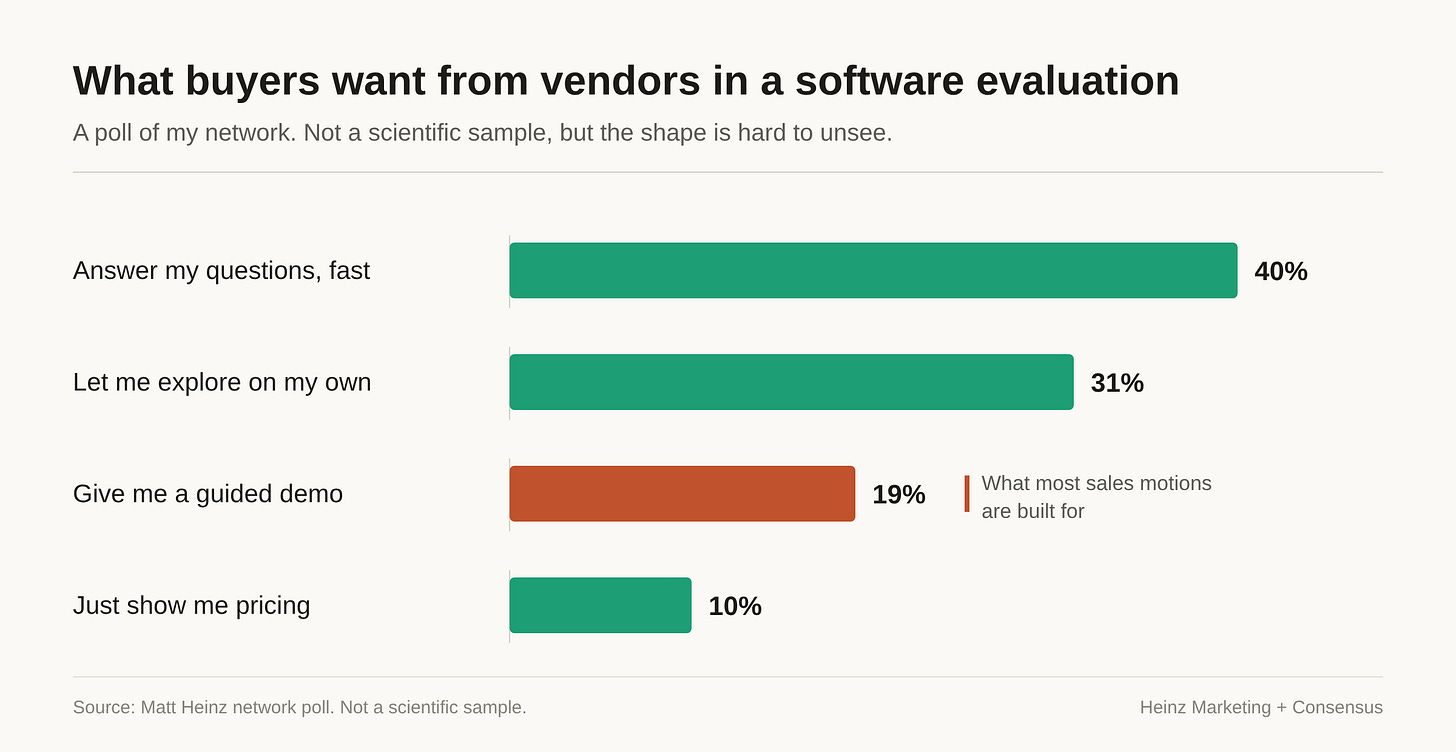
40 percent said answer my questions, fast. 31 percent said let me explore on my own. 19 percent wanted a guided demo. 10 percent just wanted pricing.
Most sales motions are built for the 19 percent.
They show up with a shortlist already built
6sense recently surveyed more than 4,000 buyers and found 94 percent of buying groups had ranked a preferred vendor before their first contact with a seller. They went on to buy that preliminary favorite 77 percent of the time.
The same research found first seller contact moving from 69 percent of the way through the journey to 61 percent in a single year. So buyers are reaching out earlier than they used to, with a shortlist and a working answer they want checked.
The rep who shows up prepared to discover is answering a question nobody is still asking.
In the win/loss analysis we run with clients at Heinz Marketing, the losses that sting most are deals where the champion couldn’t carry the room.
Two numbers that look like a contradiction
Gartner recently published two findings from related surveys of B2B buyers. 67 percent of buyers prefer a rep-free experience, up from 61 percent the year before. And 69 percent of those same buyers prefer to validate AI-generated insights with a sales rep.
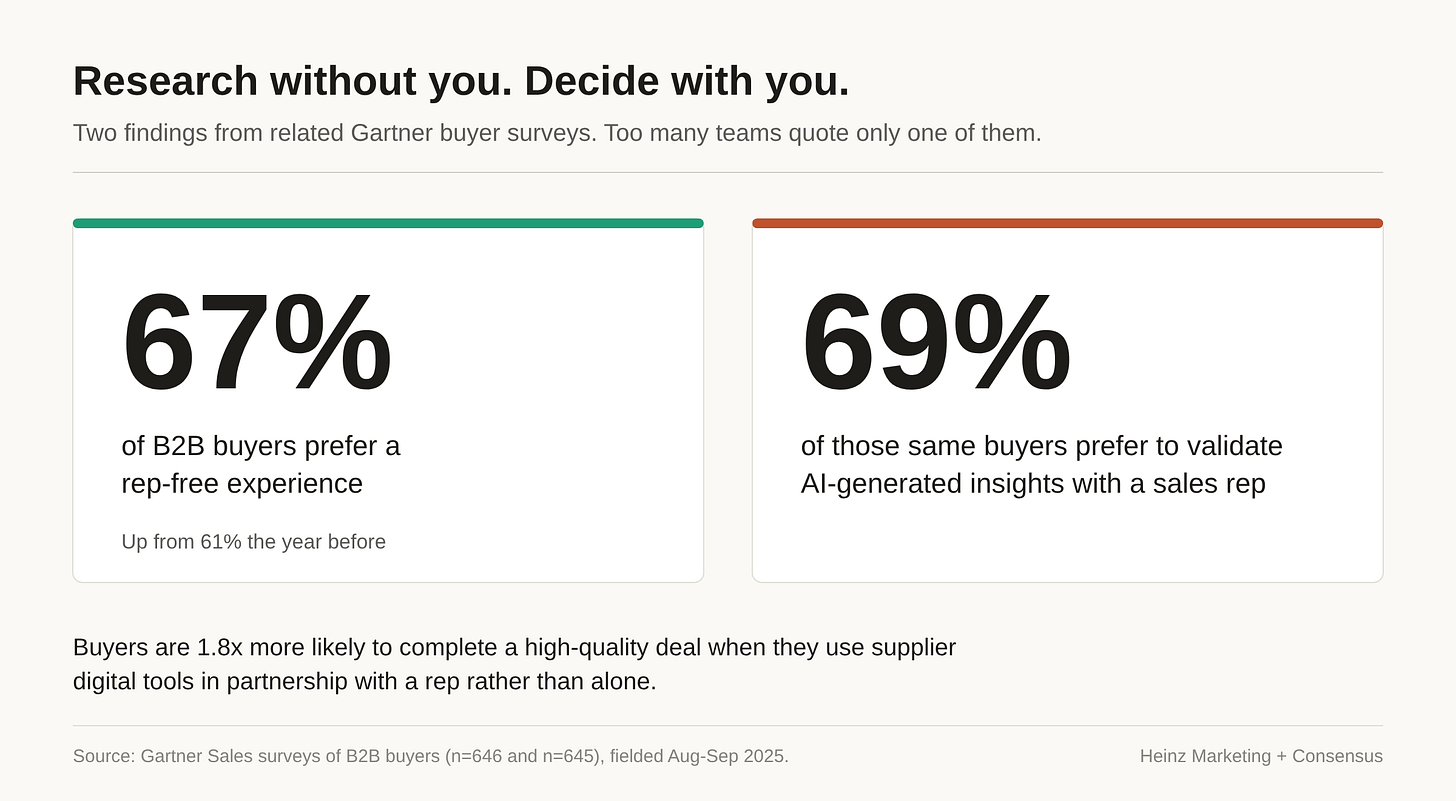
Too many teams quote one of those numbers and build a whole strategy on it, when the useful version holds both. Buyers want to research without you and decide with you.
Gartner also found buyers are 1.8 times more likely to complete a high-quality deal when they use supplier digital tools in partnership with a rep rather than alone.
The Buyer Confidence Curve
The framework at the center of the guide maps two capacities across the four stages of a buying decision: what your product experience can carry and what only a person can add.
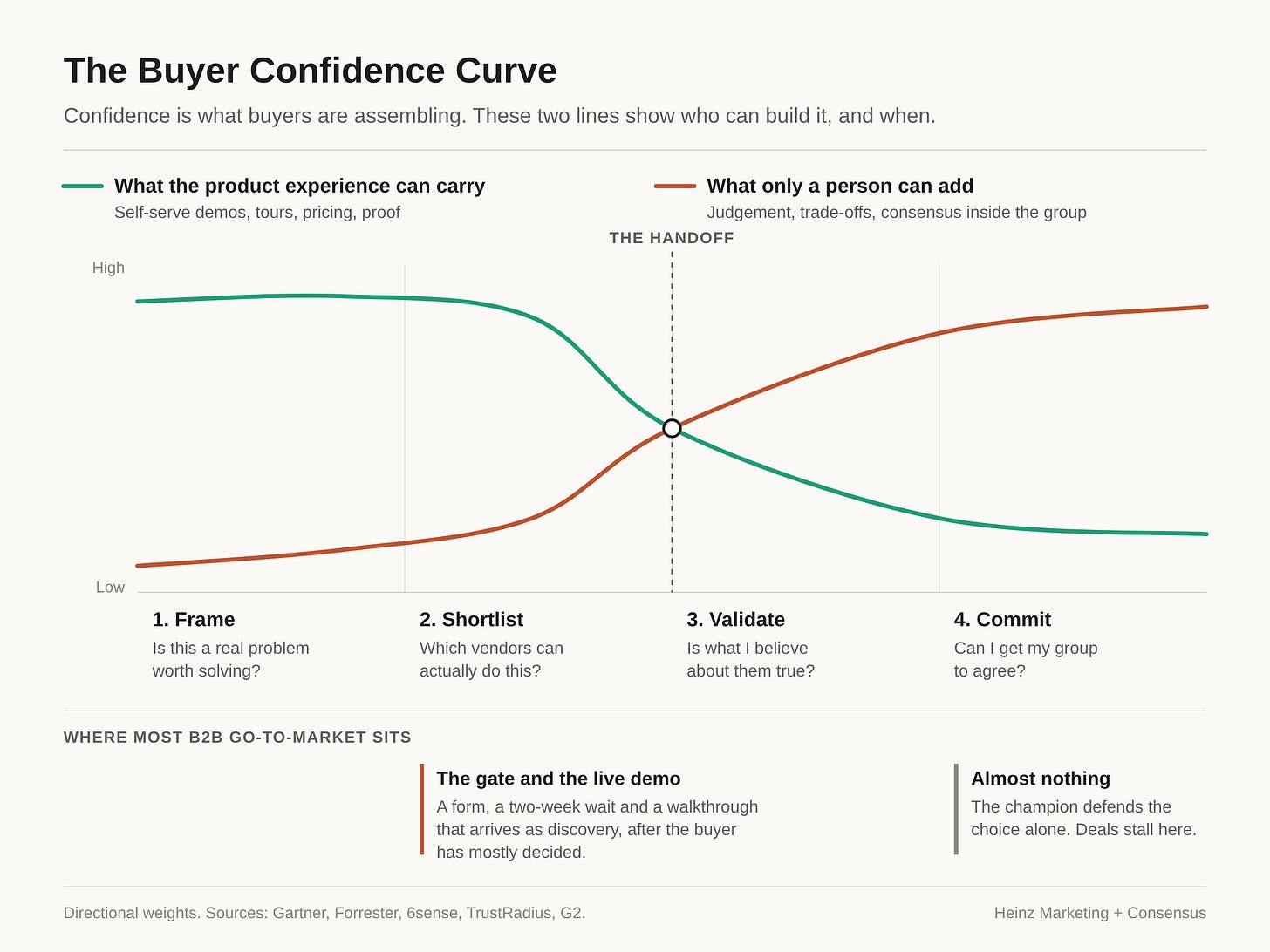
- Frame: Is this a real problem worth solving?
- Shortlist: Which vendors can actually do this?
- Validate: Is what I believe about them true?
- Commit: Can I get my group to agree?
Your product experience can do nearly all the work through Shortlist. The lines cross once, at Validate, where the buyer has a favorite and an argument (assembled from sources you don’t own) and needs somebody credible to pressure-test it. That’s also the highest-leverage half hour your team will spend on the deal.
Most companies put their expensive human hours on the wrong side of that crossing. The gate sits at Shortlist, exactly where the buyer could have convinced themselves. The live demo sits there too, arriving as discovery after the buyer has mostly decided. And almost nothing sits at Commit.
Commit is where deals die (and almost nobody is staffed)
Gartner found 74 percent of B2B buying teams show unhealthy conflict during the decision. An earlier Forrester survey found 86 percent of B2B purchases stall somewhere in the process.
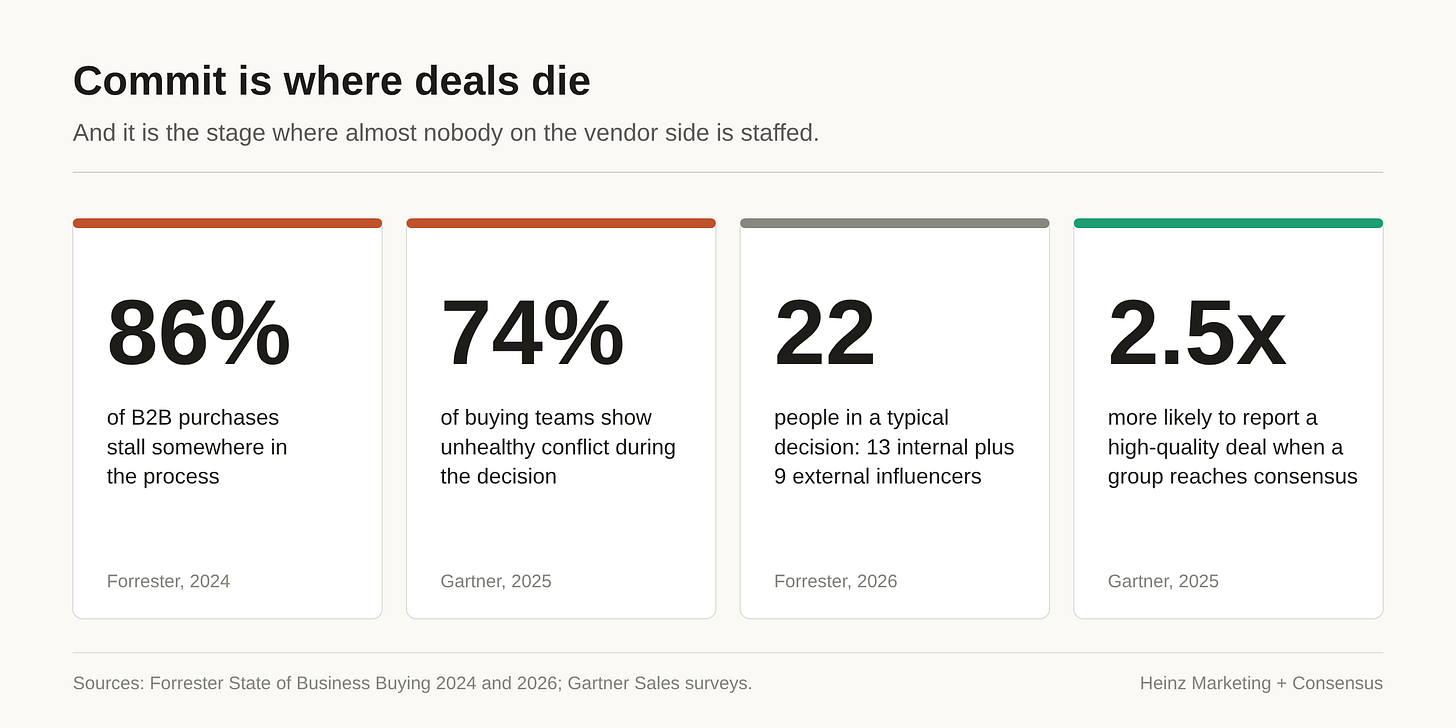
Four people on the buying committee say yes, one is a soft “no” and the deal quietly dies. Your champion is stuck defending a choice to a group that didn’t make it, usually alone, usually on a Tuesday and usually with a deck you built for a different audience.
What to do about it (four plays)
The guide goes deeper on each of these, including what good looks like. The short version:
Move the gate to where it buys you something. Ungate the product experience through Shortlist. An on-demand walkthrough, an interactive tour, a real price range and a proof point that matches their industry should all be reachable without a form. TrustRadius found free trials had the highest influence-to-usage ratio in its research, with 74 percent of buyers who used one calling it the most influential resource in their evaluation. Ungating everything and capturing nothing leaves your team blind, though, so trade the form for instrumentation: who watched, what they replayed, where they stopped and who they forwarded it to.
Design the demo to travel. Your champion is going to retell your story to people who weren’t on the call, usually from memory. Build the product experience in segments they can forward selectively (the security lead doesn’t need the same nine minutes as the CFO). When people you’ve never met start watching those segments, you’ve discovered the buying group without asking anybody to fill out an org chart.
Re-point the live conversation at validation. Open with what the buyer already believes and skip the discovery questions the demo already answered. Be willing to say where you’re the wrong fit. Gartner found 51 percent of buyers think they’re more likely to encounter misleading information from generative AI, against 49 percent who say the same of a sales rep. Neither side is trusted by default, which makes being specific about your limits the cheapest credibility available.
Enable the group, not the individual. This is the play almost nobody runs, and it has the most room. Gartner found buyers experiencing content relevance at the buying-group level were three times more likely to report a high-quality deal. Hyper-personalizing to each stakeholder can backfire: everybody gets their own version of the truth and then they can’t agree on which problem they’re solving. Build a shared summary of what the group has collectively seen, a one-page answer to the objection procurement always raises and proof points the CFO can forward without translation.
Score yourself first
The guide closes with a 10-question diagnostic. A few of the questions:
- Can a stranger see your product working, in a meaningful way, without giving you an email address?
- When a buyer books a live meeting, does the rep know what that buyer has already seen?
- Do you have a named owner for buyer enablement, with a roadmap and a number?
- Can you name the stage where your deals most often stall, from data rather than from a feeling?
It also swaps demo requests (which tell you about your form and almost nothing about your buyer) for four better metrics, starting with stakeholders discovered per opportunity.
Pick one stage of the curve, find out where yours is inverted and fix that one first. The full field guide, with the curve, all four plays and the diagnostic, is free to download. No form required, obvy.
This post originally appeared on Matt Heinz’s Substack.