5 Takeaways for CMOs as AI Agents Step Into Marketing Leadership Roles
 Payal Parikh
Summary
At some small startups, AI agents are already doing the VP of marketing job. SaaStr’s “superagent” 10k helped the company skip backfilling about 10 roles. But that doesn’t mean CMOs should step aside. Here are 5 takeaways from the Wall Street Journal’s reporting on how marketing leaders can put agents to work, keep humans in charge and make judgment their edge.
Most of what I see in the news about AI and marketing is about tools, prompts, use cases, and productivity hacks. But a recent Wall Street Journal article got me thinking, a little worried, and a little hopeful. The headline: Can an AI Agent Be Your Next CMO? At Some Small Startups, It Already Is. It talks about AI agents in marketing leadership roles. Why worried you ask? Obviously! Why hopeful you ask? Imagine how much momentum can a one or two person team can gain! Imagine hiring once you have that momentum!
At SaaStr, an events company for software businesses with just three full-time employees, the VP of marketing role has been held since March by an AI “superagent” named 10k. Amelia Lerutte, who used to hold that title and is now SaaStr’s chief AI officer, starts every workday by checking in with it. 10k leads a digital workforce that helped SaaStr avoid backfilling roughly 10 roles, including a four-person marketing team and the CFO.
So what should CMOs do with that mix of worry and hope? Here are 5 lessons I took away from the article, and how marketing leaders can use them to get ahead.
1. Agents are moving up the org chart
For the last couple of years, the conversation about AI and jobs has focused on entry and mid-level work. Not anymore. Startups like CellCog now sell agents built to act as a head of marketing, a growth manager or a chief of staff. Their top sellers? Marketing, growth and engineering agents.
CellCog’s founder, Nitish Garg, even built his own AI head of marketing, named Maeve, when he got frustrated with his company’s pace of growth.
How does this translate to your marketing team?
If you lead a lean marketing team, and most B2B teams I work with are lean, you are right where this shift starts. Every company in the article was running with a very small headcount before agents came in.
Take a hard look at your team’s week. Which work is repeatable? Think campaign builds, reporting, list pulls and first drafts. Which work needs judgment? Think positioning, budget calls and messaging. That repeatable list is your starting point.
2. Start with one workflow and let it run end to end
At SaaStr, 10k does far more than write emails. It suggests a new campaign, writes and designs the emails, tests variations and reports on results. It also works with sponsors and handles customer service.
And the results are real. Only 8% of SaaStr’s invoices have been late since agents took over the process, down from 56% when humans handled it. That is not a small improvement.
How does this translate to your marketing team?
Don’t sprinkle AI across 20 different tasks and hope something sticks. Pick one workflow, like your nurture program or your weekly pipeline report, and let an agent own the whole loop.
Then measure it the way you would measure a new hire. Speed, quality, cost and outcomes. Get a clear before and after, just like SaaStr did.
Not sure where to start? Map how work actually moves across your team first. That is the heart of marketing orchestration, and it makes your first pick much clearer.”
3. Human oversight is not optional
Every person interviewed in the article agreed on this one. Linara Bozieva runs her marketing firm, Ravenopus, with just herself and 35 agents. Her take: “I don’t think that you can hire that team, then not pay any attention to what they are doing and expect that there will be a good result.”
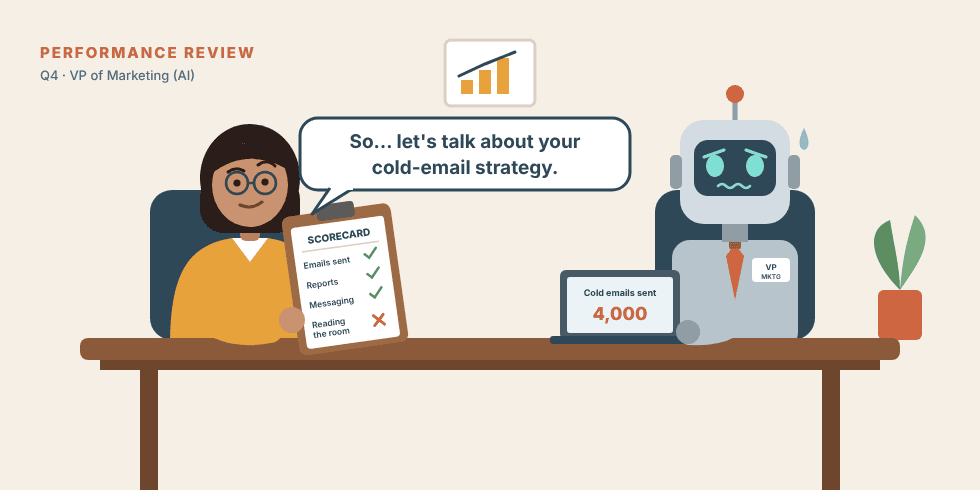
Why? Agents can get thrown off by too much data, or by small changes in the AI models and tools they rely on. They also miss the nuances of human communication. 10k once suggested getting endorsements by cold-emailing the best-known speakers from SaaStr’s past events. Lerutte’s response: “If only it were that easy.”
How does this translate to your marketing team?
Set your guardrails before you hand anything off. Decide what an agent can publish on its own and what needs a human sign-off. Brand voice, pricing and anything customer-facing with real risk should have a person approve it. Write it down so everyone is on the same page.
And don’t just review the work at launch. Schedule regular check-ins on quality, because agents drift.
4. Managing agents is a real job
This was my favorite detail in the article. Lerutte spends a large part of every day either talking to 10k or reviewing its team’s work. She called managing agents that are “constantly working” a lot of mental overhead. SaaStr is now looking for two people just to help manage its agents.
How does this translate to your marketing team?
Agent management is a skill, and your team needs to build it. Train your people to brief, review and correct an agent the same way they would coach a new team member. For someone on your team, this could become a real career path.
Also, be intentional about the time you get back. If agents free up 10 hours a week, decide where those hours go. More customer conversations? Sharper competitive strategy? Better alignment with sales?
5. Judgment is still your edge
I loved how candid Garg was about his AI head of marketing. “I’m not a marketing person,” he said. “I don’t know how people think.” Maeve is not a long-term replacement. He plans to hire a human for the role as soon as his company earns enough revenue.
Jesse Vincent, founder and CEO of AI research lab Prime Radiant, went further. Major strategic decisions depend on the kind of taste, judgment and leadership that set humans apart, and he cautions against handing them to agents. I could not agree more.
How does this translate to your marketing team?
Lean into the work agents can’t do well:
- Knowing what is on-brand, what is clever and what is tone-deaf.
- The customer, partner or analyst who takes your call because they trust you.
- Strategic bets. Which market, which segment, which story.
- Reading people. Buyers, boards and sales leaders. Agents miss nuance. Nuance is your job.
Agents can execute a campaign. They cannot build trust with your biggest customer over a cup of coffee or a glass of wine.
The bottom line
The CMO role is not going away, but it is changing. The marketing leaders who win won’t be the ones who resist agents. They also won’t be the ones who hand over the keys and walk away. They will be the ones who learn to lead a team of people and agents, and keep the big judgment calls for themselves.
This is part one of a two-part series. In part two, coming in December, I will walk through a step-by-step guide to putting your first AI agent to work on your marketing team.
And if you are trying to figure out where agents fit in your marketing team, Heinz Marketing can help. Reach out for a free consultation.
Image Credit: Claude