AI Visibility in B2B Marketing
 Sarah Threet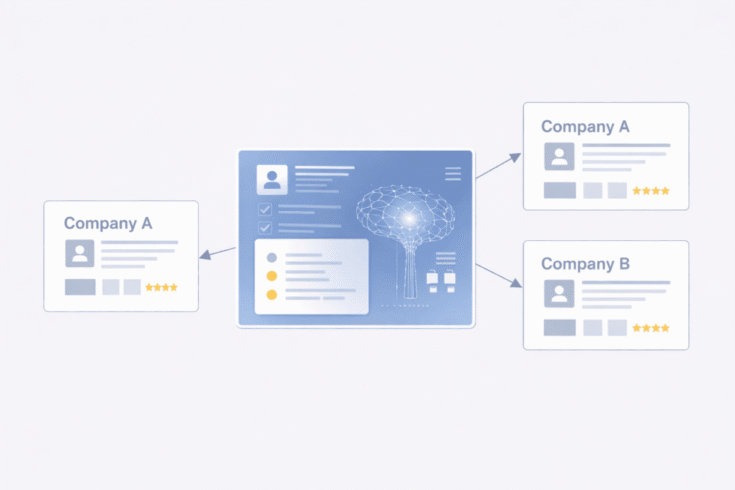
Summary
AI visibility is reshaping B2B marketing. If AI can’t understand your brand, you won’t show up in how buyers evaluate solutions. Read on to learn what’s changing and how to stay visible in an AI-driven buying journey.
By Sarah Threet, Marketing Consultant at Heinz Marketing
For years, B2B marketers have optimized for search: Keywords. Rankings. Traffic. Conversion paths.
But quietly, and quickly, the mechanics of discovery have changed. Buyers aren’t searching the same way anymore. They’re asking. They’re turning to AI tools to:
- Summarize vendors
- Compare solutions
- Shortlist providers
- Recommend next steps
And in that shift, a new requirement has emerged: It’s not enough for your content to rank. It has to be understood.
From Search Engines to Answer Engines
Traditional SEO was built around helping humans find you. AI-driven discovery is about helping machines interpret you.
According to The 2026 State of B2B AI Visibility, buyers are increasingly delegating research to AI systems that synthesize answers instead of returning links. That means your brand is no longer competing for position on a results page, rather, it’s competing to be included (or excluded) from a generated answer.
In other words:
- SEO = “Can I be found?”
- AI visibility = “Can I be represented correctly?”
Right now, most B2B organizations are not prepared for that second question.
The Problem: We Built for Readers, Not Machines
Most marketing content today is optimized for persuasion, not extraction. It tells stories, it builds narrative, and it creates emotional connection. And while that still matters, the truth is that AI systems don’t consume content the same way humans do. They look for:
- Structured information
- Clear definitions
- Consistent terminology
- Accessible data
The AI Visibility report calls this a “narrative disconnect”: companies are writing for readers while AI systems are trying to extract facts. That disconnect leads to:
- Incomplete or incorrect summaries
- Missing positioning in comparisons
- Hallucinated product details
- Exclusion from recommendations entirely
Most teams won’t see this happening, because it doesn’t show up in your traditional analytics.
Visibility ≠ Readiness
One of the more interesting findings from the AI Visibility research is what it calls the “authority trap.” Well-known brands are still showing up in AI-generated answers, not because they’re optimized for AI but because they were included in model training data. That creates a false sense of security. It looks like visibility, but it’s not control.
As AI systems evolve toward real-time retrieval and agent-based workflows, that advantage will erode. What will matter instead is whether your content is:
- Machine-readable
- Structurally consistent
- Accessible to AI systems
This is where most B2B organizations are behind.
Why This Matters More Than Internal AI Right Now
There’s been a lot of focus on internal AI use cases like content generation, workflow automation, and productivity gains. Those are valuable, but they’re not where the biggest opportunity, or risk, lives.
The AI Visibility report makes a clear argument that the highest ROI opportunity in AI right now is external visibility, not internal efficiency.
While teams were optimizing internal workflows, buyers changed how they buy. If your brand isn’t showing up accurately in that process, you’re not just losing traffic—you’re losing consideration before your pipeline even forms.
The Hidden Barrier: Your Website Might Be Blocking AI
Many B2B websites are unintentionally preventing AI systems from accessing or understanding their content. Common issues include:
- Heavy JavaScript rendering
- Gated or inaccessible product details
- Lack of structured data
- CAPTCHAs or form barriers
The AI Visibility study found that while ~90% of sites are optimized for human conversion (“Contact Sales”), they often create “agent blockades” that prevent AI systems from progressing through the journey. This creates a new kind of funnel leak: not at conversion; not at engagement; at interpretation.
Context Is the New Differentiator
When we zoom out, this problem isn’t about content, rather, it’s about data and architecture. In Martech for 2026, one of the insights that stands out is that, “AI is a commodity. Context is differentiation.”
Most teams are still thinking about AI as the advantage. But increasingly, AI itself is becoming widely accessible. Your competitors have it. Your buyers are using it. Your partners are integrating it. So the question shifts from “Do you have AI?” to, “What does your AI actually know and how well can it act on that knowledge?”
What separates companies is how well they provide:
- Structured data
- Connected systems
- Accessible context
Similarly, The New Martech Stack for the AI Age emphasizes the need for a unified data foundation and composable architecture to support AI-driven experiences. Only 23% of organizations reported having AI agents in full production, while the majority are still experimenting or running limited use cases. At the same time, 56% cited poor data quality as a major barrier to AI success.
This applies just as much to external visibility as it does to internal operations. If your systems, and your content, don’t provide clean, usable context, AI won’t be able to represent you accurately.
What B2B Teams Should Do Next
This isn’t about abandoning SEO. It’s about expanding your definition of visibility. Here are a few practical starting points:
Audit How AI Describes You
Ask tools like ChatGPT:
- “What does [your company] do?”
- “Compare [you] vs competitors”
- “Best vendors for [your category]”
Look for:
- Accuracy gaps
- Missing positioning
- Inconsistent messaging
Make Your Content More Extractable
Think less like a storyteller, more like a system designer.
Prioritize:
- Clear product descriptions
- Structured FAQs
- Consistent terminology
- Explicit differentiation
Reduce Friction for Machine Access
If AI agents can’t navigate your site, they can’t recommend you.
Evaluate:
- Page accessibility
- Structured data (schema)
- API or data availability
- Technical barriers
Align Messaging Across Channels
AI systems synthesize across sources.
If your:
- Website
- Third-party listings
- Analyst reports
- Customer content
…are inconsistent, your positioning will be too.
Treat AI Visibility as a Strategic Function
This isn’t just SEO. It’s not just content. It sits at the intersection of:
- Product marketing
- Content strategy
- Marketing ops
- Data architecture
Which means it requires orchestration, not just optimization.
Final Thought: You’re Not Just Marketing to Buyers Anymore
The important shift here is this: You’re no longer just influencing people; you’re influencing the systems they rely on to make decisions.
And those systems don’t care how compelling your narrative is if they can’t understand it.
So the question becomes: If an AI had to explain your company in one sentence, would it get it right? Increasingly, that’s the version of your brand your buyers will see first.
If you’re starting to realize this isn’t just a content challenge, but a coordination, data, and GTM orchestration problem, we are happy to provide you with a free GTM orchestration assessment. At Heinz Marketing, we work with B2B teams to align messaging, data, and go-to-market execution so your strategy shows up clearly to both buyers and the systems guiding them.