B2B marketing lessons from real AI implementations
 Tom Swanson
Summary
B2B marketers are figuring out how to use AI. New solutions for old use-cases come up every day. This post goes through a handful of different use-cases we have seen with real implementations. We cover using AI for data enrichment, chunking knowledgebases, and delivering quality over quantity.
By Tom Swanson, Senior Engagement Manager at Heinz Marketing
There are plenty of resources about use cases and how to set up and use AI. Agents, RAG tools, pure generative stuff, data analysis, there are many use cases and even more blog posts and whitepapers about them. Here are a few great posts from my colleagues:
As a B2B agency guy, I see a lot of AI implementations from a diverse array of companies, teams, and organizations. Today, in this post, I am going to share some lessons learned and stories from the field. Some of these were AI implementations I was involved in, some of them I just observed from afar.
The goal here is to provide some insight and wisdom from our experiences. Seeing this highly varied set of projects and outcomes is, after all, one of the biggest benefits of being in agency today.
Working around ZoomInfo
Not every tool is a great fit for every company. One of the best use-cases I have seen for AI is custom tooling for niche situations.
For companies targeting local businesses, rather than your typical ABM, big enterprise folks, tools like ZoomInfo have quickly diminishing returns. If the business isn’t big enough, it won’t find the info you need to act. This is a real problem because access to people is one of the bigger challenges for any company.
One company found a way around this by building a script using Claude Code. It would starts by searching weekly for businesses that meet certain criteria in public records. It then searches the web for info about those businesses based on what it could find and fills in as many blanks in a template as possible.
This workflow is set up on a cloud server to trigger every week, and it works great. Claude and its agent were able to easily get double the data that was doable with ZoomInfo, in this particular setting.
ZoomInfo was the right fit for the larger, strategic function of the company. However, for the folks working local SMBs, Claude was super helpful.
Use AI to reduce the demands on requesting teams
I recently was developing a full-team workflow as part of a Marketing Orchestration engagement. Part of the remit with this project was evaluating bright spots in team functions, and we sure did find a good one.
The particular team was a demand gen team that served multiple stakeholders from different business units. The situation had all the indicators of potential disaster:
- Stakeholders spread across 5+ discrete business units
- Customized output needs
- Fast timelines and frequent ad hoc work
- High visibility with executive leadership
- Multiple workflows to complete efforts
- Competing priorities
- Inconsistent request formats and information
The first problem to solve was the inconsistency of request formats and information. In order to execute in a timely way, they needed to ensure intake was consistent. So they did this using AI, not by requiring requestors to fill out a big briefing document.
AI is great at taking unstructured data and structuring it. With a small context window, the likelihood of errors is low. Requests can come in any format, and then AI standardizes it and confirms it with the requestor and actioning team.
This effectively removed the issues at the start of their overall workflow. This had a few benefits, but the most important of them was the ability to get projects in the queue, adequately understand the time and effort needed, and give an accurate timeline.
Another benefit is that by removing issues at the front of the workflow, they could more clearly see where their other issues were. So many workflow issues are “garbage in, garbage out” issues, and by removing the garbage in, they then knew where the other real problems were.
Marketers don’t understand chunking
This one comes from a project I am actively working on. I didn’t understand chunking, now I do (kinda) and am excited to share it with you.
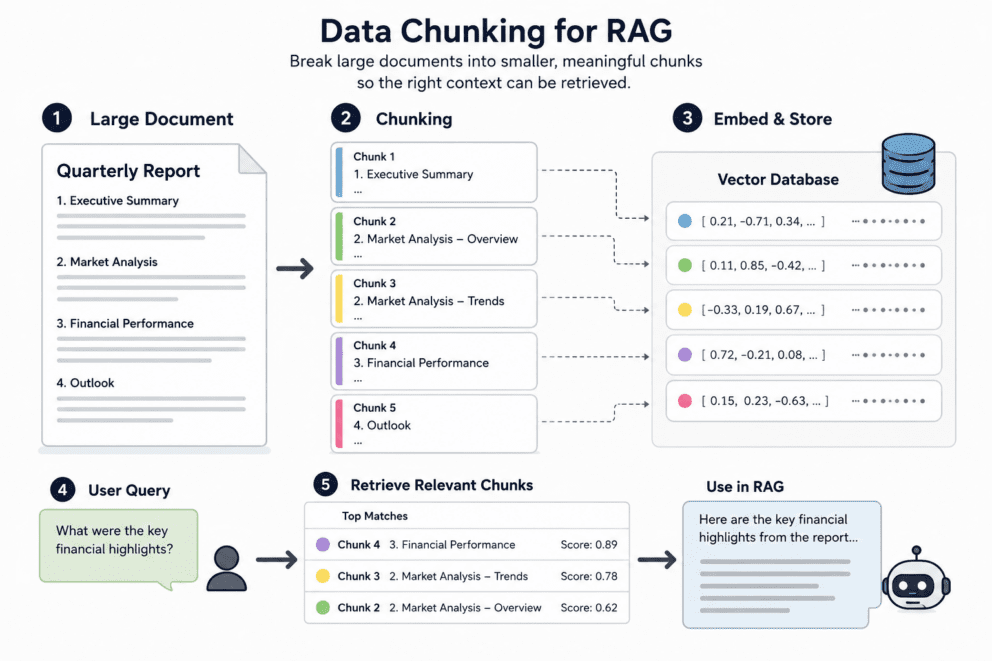
Retrieval Augmented Generation (RAG) is a pretty common term these days. In essence it refers to giving a LLM a knowledge base to improve its ability to respond. The knowledge base could be anything. The idea behind this is that to get away from generic LLM answering, you have to give it primary sources to access that aren’t just out there on the internet.
The problem with a knowledge base is that if it is big, it can slow things down and use tokens (assuming you are working via an API). With many runs, this becomes expensive in both time and money.
I learned this the hard way, as I started a project and built out a robust knowledge base, only to find my execution times and token usage far higher than expected.
What I found is that knowledge bases need to chunk things down. Essentially it breaks up the knowledge base documentation into chunks which are assigned classifications based on characteristics of the chunk (this is called Vectoring). It basically just tells the
If you are looking to build any kind of RAG tool, here are my recommendations:
- Chunking requires an additional tool, assume $20/month for small packages.
- Use an LLM to review the knowledgebase beforehand and work on a classification scheme for you.
- Spot check the classification scheme once the chunking is complete.
- Test, test, test.
- When something goes wrong in your outputs, check the chunking first.
Speed is good, quality is better
AI as a strategist is still something that gives people some pause. Probably for the best. AI strategy still requires a decent amount of human touches to excel. AI is very helpful when given all the best info, but it still lacks the finer points of taking calculated risks such as investing in a new channel or using more exciting brand plays.
Many of my clients have been looking to AI to generate more campaigns, faster. However, this doesn’t necessarily produce great results. If you are looking to do a pure volume play on known channels, with standard creative, then go for it.
This is not as common in B2B marketing. When the sticker price is bigger, the CAC is bigger, and volume just doesn’t do as much. The market is already inundated with ads and content. Even moreso now with AI.
In particular case, the remit was to use AI to drastically reduce the time from campaign ideation to execution. This client was successful in that effort. They used AI and their briefs were standardized, SLAs shortened, and outputs become consistent.
But performance didn’t improve. AI writes great stuff for AI, but it all starts to look the same to a human. Right now, AI does a lot of the research for buyers, but the buyer is still a person. They still have to decide they want to book a meeting. They still have to like and trust the brand.
The result for this client was to keep the elements of the AI tooling, but slow it down a bit by integrating humans at the points when the strategy needed some creativity and human understanding. I found it fascinating to see, because there are essentially two needs to serve:
- You want AI to generate content for AI to research on behalf of the buyer.
- You want people to make the content for when a human needs to take an action such as booking a demo.
This is still nascent thinking for me in terms of logistics, but a proper AI workflow should use the best parts of your entire system (people, tools, and process).
Conclusion
This stuff is changing all the time. I am sure one day that AI will be great at writing for people. But for now, this is what we have learned from living and working in the AI-enhanced marketing world. If you are interested in talking more, I am happy to share more stories. You can find me at acceleration@heinzmarketing.com