How to Improve Marketing Docs for LLMs
 Tom Swanson
Summary
5 simple, pragmatic steps to improve outcomes when using LLMs (both directly and through agents)
1. Use the LLM to draft a prompt based on your documentation to see what is needed/solve issues with prompts.
2. Update naming conventions to include purpose, audience, version, and date.
3. Deprecate old versions in live knowledge bases.
4. Include negative examples.
5. Summarize important docs.
By: Tom Swanson, Senior Engagement Manager, Heinz Marketing
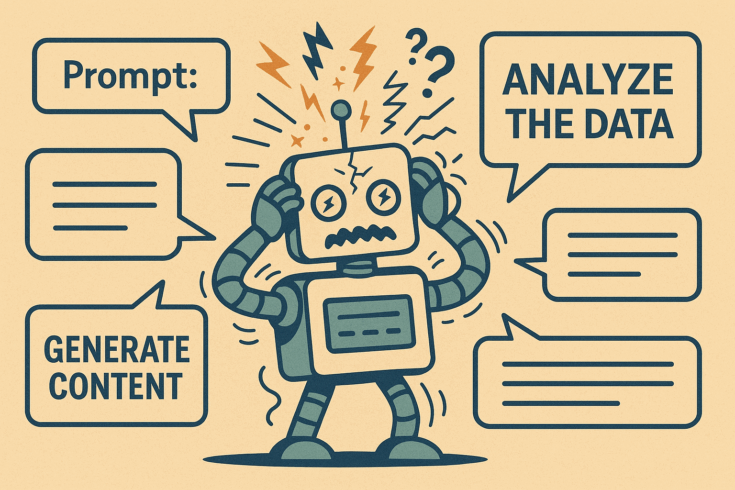
Developing marketing campaigns with LLMs (whether directly or with agents) comes with a lot of time spent reworking prompts and often clarifying data. Prompts are reusable, so the time spent is worth it. Marketing documentation often goes stale and needs to be updated frequently. This is particularly true if the agent is using live docs.
If you are using, or plan to use, tools that utilize knowledge bases (such as custom GPTs and many agents), they would likely benefit from some updates to their structure and naming conventions. Many of these things are going to be beneficial to both people and machines.
Quick aside: keep up with the AI news with our B2B reads.
Let’s face it, marketing strategy docs often wind up on shelves. LLMs, however, use them all the time. If you want agents as part of your team, it makes sense to tweak your documentation to work for them.
The goal here is to reduce the amount of rework and adjustment needed to get consistently good results from LLMs. This requires the removal of some space for creativity, so if you want the variance then adjust my approach. I think the next 3 points are relevant to all. 
Lots of this can be solved with proper prompting so we can start with that:
Show docs/goals to LLM and have it draft the prompt
If you are reusing prompts, which you should, this is going to save a lot of time. Use the relevant LLM to develop a prompt for itself using best practices and based on the documentation and goals you provided. Open another chat and upload your docs with the prompt and see what comes out. Then you can iterate as needed.
In the end, the prompt should produce good and reasonably consistent results, though there will always be variance.
Just make sure that if you update/change how you do those documents that you revisit the prompt.
Other stuff
Prompts are the top priority, but you can also adjust some more consistent elements of your documentation to further improve accuracy and reduce reworks.
Here are some straightforward things that I am playing around with that help.
Get descriptive with your titles
Most folks we work with do this already but it is still important. If you have any live access, it is crucial to manage how the documents are named and organized. At the very least, it helps the LLMs interpret and select documents faster.
- Include the function of the doc (like “buyer-persona CIO” instead of “CIO”)
- Add versioning for major changes
- Keep it single-layer
- Works better than just a folder
- Include date and update when editing
- Include target when relevant (i.e. campaign plan – IT target Q1 – V2 – 12.8.25)
The titles get longer on the screen, but having that information at a glance is helpful to everyone.
Deprecate old versions
Along the same lines as some others here, telling the LLM what not to use is just as important. If you are just uploading to a database and not removing old docs, or if you have a live database, you will want to indicate versions that are no longer in use.
This requires occasional audits of knowledge bases to look for out-of-date things like personas, branding documents, any templates, and even data sets if you are using static ones in .csvs or spreadsheets.
I don’t mind a bit of clutter in doc names if they are communicative, so I prefer to just put DEPRECATED in the title. If you prefer to have a more streamlined look, you can include this information in the doc itself.
Include Negative Examples

This one isn’t all that common in human-focused documents, but negative examples are great. Personas make an excellent use-case.
Specific targeting performs better. Negative examples might say “This persona does not care about…” or “Titles do not include…”. This will impact anything that the personas are used for from audience-building to optimization.
Humans don’t need this since they will remember this sort of thing, but your LLMs are coming in fresh unless they have this context.
Summarize (for important docs)
Executive summaries exist for a reason. They are super helpful to both humans and machines. Include a short, summarizing paragraph that goes over the purpose of the doc, most important 2 or 3 points, and any constraints (i.e. only for X audience, or internal use only)
While LLMs can do a great job summarizing, I have found indicating the most important points helps to ensure those make it into the final results.
Not every document needs this. A persona, to continue the above example, are already summarized and don’t need this, but a deck of personas might. Another good example would be that a messaging framework doesn’t need this but a full positioning document will.
If you are using any reports, those also need a solid summary for both human and machine users.
As a bonus, if you are deprecating versions, the summary is a great place to indicate that.
Doc work never ends
Sadly AI cannot free us from document management… yet anyway.
If you want the best results from LLMs, you need to give it things to work with that your competition cannot. Just using the publicly available information, templates, and thinking will get you the publicly available results. You have to add something to the process to make it worth it.
For those of you just dipping your toes into agents: most agents use LLMs to interpret documents for them. If anything, this is more important for agent-based approaches to AI than just using ChatGPT or Claude in its UI (for example with customGPTs and their knowledge bases).

When I was just getting started in my career, I was building websites at a local digital agency. Being a marketing major, I had to learn a bit of simple programming and database management. The best piece of advice I got was:
“Think as if you were the machine”.
If you have ever done the PB&J experiment, you know what I mean. It is the same thing here. You get a bit more flexibility thanks to modern technology, but the concept remains.
If you want to chat about how you can integrate and maximize AI in your marketing processes, reach out. AI is overwhelming right now, but some simple practical things can help you find the right tools and get better results.