Marketing Org Design: What B2B CMOs Get Backwards
 Sarah Threet
Summary
Budgets are flat, AI ambition is high, and the org isn't ready. Most marketing leaders reach for the org chart first. There's a faster answer, and it doesn't require moving a single person on your team.
By Sarah Threet, Marketing Consultant at Heinz Marketing
Gartner’s 2026 CMO Spend Survey found that 70% of CMOs consider becoming an AI leader a critical goal for this year. Only 30% report mature AI readiness capabilities. Marketing budgets, meanwhile, sit at 7.8% of company revenue, effectively flat.
So the ambition is set, the funding is not growing, and the organization isn’t ready. Faced with that, a lot of marketing leaders reach for the biggest lever they have: the org chart. New structure, new titles, consolidated teams, maybe a reduction.
That’s the backwards answer to a marketing org design problem. Not because structure doesn’t matter, but because it’s the slowest, most political, most publicly visible tool available, and it usually gets pulled before anyone has diagnosed what’s actually slowing the team down.
The gap is structural, not technological
McKinsey’s State of AI research puts a number on this: roughly 6% of organizations qualify as AI high performers, meaning they attribute at least 5% of EBIT impact to AI use and report significant value from it. Those high performers are nearly three times as likely as everyone else to say they’ve fundamentally redesigned individual workflows. Of the 31 organizational variables McKinsey tested, that intentional workflow redesign had one of the strongest contributions to meaningful business impact.
The implication is uncomfortable. The 6% and the other 94% have access to broadly the same models, platforms, and vendors. What separates them is how the work is arranged.
This is also why AI tends to make existing process problems louder rather than quieter. As our team has written about B2B GTM AI strategy, AI doesn’t create misalignment between marketing, sales, and RevOps. It removes the buffer that was absorbing it. If your teams can’t articulate why a lead was prioritized, adding automation to the prioritization step produces faster output that nobody trusts.
Marketing org design starts at the handoff, not the box
Here’s the practical reframe: the unit of org design worth your attention right now is the handoff, not the reporting line.
Most B2B marketing and sales organizations are competently staffed at every stage and structurally weak at every transition between stages. Content produces an asset and hands it to campaign. Campaign launches and hands the resulting engagement to sales enablement. Sales enablement hands a lead to a rep. Every one of those functions has an owner. The transitions between them frequently don’t.
That’s where cycle time actually goes. A campaign that takes six weeks rarely spent six weeks in production. It spent two weeks in production and four weeks waiting in the gaps between owners: waiting for a review, waiting for clarification on a decision nobody had authority to make, waiting for a rework loop that could have been avoided if the brief had specified the thing the reviewer cared about.
We’ve called the accumulated cost of this orchestration debt, and the reason it matters more in an AI context is that deploying agents inside silos does nothing about it. Give the content team a drafting agent and content gets faster. The campaign still takes six weeks, because the four weeks of waiting were never in the content team’s control.
The organizations that fix this treat alignment as something engineered rather than encouraged. As we’ve observed in what successful VPs of Revenue Marketing do differently, it comes down to shared definitions, shared metrics, and shared accountability, embedded in operations rather than left to good intentions. Which means the highest-value redesign available to most CMOs isn’t a new structure. It’s naming an owner for one revenue-critical workflow end to end, across the marketing-sales boundary, with the authority to change how the handoffs work.
If it isn’t documented, it isn’t automatable
There’s a second constraint hiding underneath all of this, and it’s the one most likely to stall an AI initiative that looked well-scoped on paper.
Agents can’t inherit tribal knowledge. A person who has run campaign QA for four years carries a mental model of what gets flagged, which stakeholders need a heads-up, which exceptions are fine and which ones are career-limiting. None of that is written down, and it doesn’t need to be as long as that person is in the seat.
The moment you try to hand any part of that workflow to a system, the undocumented logic becomes the blocker. You’re not automating a process. You’re discovering that the process was never a process — it was a person.
Most CMOs already frame this as a succession risk: if we restructure and people leave, we lose context nobody captured. That’s true, and it understates the problem. The undocumented workflow is constraining you right now, before anyone resigns.
It also dissolves a hiring problem a lot of teams are struggling with. The job descriptions that read like unicorn hunts — strategic thinker who can also prompt well, interpret data, and run a workflow — are usually a symptom of an undocumented workflow. When the logic of the work lives in someone’s head, the role has to absorb all the ambiguity, so you write a JD for someone who can figure it out. Document the workflow and the role becomes hireable.
Decision rights come before reporting lines
The genuinely new org design question isn’t where agents sit on a chart. It’s what they’re permitted to decide.
Who authorizes an agent to spend budget? To publish without review? To reprioritize a lead and change what a rep does on Monday morning? These are decision rights, and most marketing organizations have no precedent to copy because the question has never applied to a non-human actor before.
This is also where the market is quietly stuck. Digiday reported that even technically fluent teams building agents in-house are largely scoping them to contained tasks rather than end-to-end control. The appetite for autonomy is real. The appetite for liability is not.
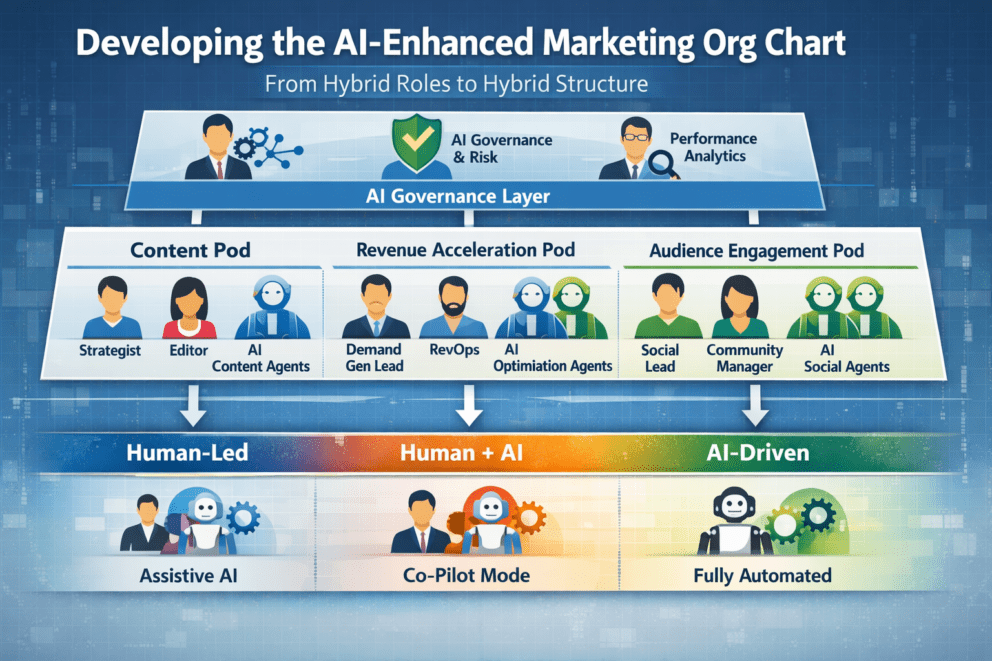
The useful move is to make autonomy an explicit design choice rather than a default. Our team has mapped this as a progression from assistive to partially autonomous to fully autonomous, and the work of designing an AI-enhanced org chart is largely the work of deciding which task classes belong at which tier. Routine reporting and A/B test variations are not the same risk category as pricing claims or executive communications.
That’s a governance decision a CMO can make this quarter. It doesn’t require moving a single person.
Four moves that aren’t a reorg
If the structure question feels too big to answer, start smaller:
- Map one revenue-critical workflow end to end, including the parts that live in sales. Not the org chart version. The version where the waiting is visible.
- Assign an owner to the workflow, not just to its stages. Give that person authority over the transitions.
- Document the decision logic at each handoff. What gets approved, by whom, against what criteria. This is the prerequisite for automating anything.
- Set autonomy tiers by task class. Decide in advance where a human reviews and where the system proceeds.
None of this requires a restructure, and our team has written more on how to start using AI agents without rebuilding your org chart if you want the tactical version.
The risk is not the one most leaders are managing
Plenty of marketing leaders are moving carefully here because a restructure that backfires is career-visible. That instinct is understandable and probably pointed at the wrong risk.
Gartner found that 65% of CMOs expect AI to dramatically change their role within two years, while only 32% believe significant changes are needed to their own skill set. The firm now predicts that by 2027, a lack of AI literacy will rank among the top three reasons CMOs are replaced at large enterprises. Only 15% of CEOs currently believe their marketing leaders are AI-savvy.
The exposure isn’t a reorg that goes sideways. It’s being a leader who can’t explain, in specific operational terms, how work gets done on their own team and where the machine fits. That’s answerable without touching the org chart and answering it is what makes any future structural change worth making.
Working through this on your own team? We’d like to hear where you’re stuck. Reach out at acceleration@heinzmarketing.com to talk it through.