The MQL Trust Gap: Inbound Breaks at Every Handoff
 Sarah Threet

By Sarah Threet, Marketing Consultant at Heinz Marketing
Picture a VP of demand generation on a Tuesday night, about 40 minutes into evaluating new software. She has asked an AI assistant to help frame a shortlist and read 3 vendor sites without telling any of them who she is. When the fourth site asks for her phone number, she closes the tab, which is a perfectly reasonable thing to do and leaves no trace in anyone’s funnel report.
The next morning she walks into her own pipeline review, where her team reports MQL volume to leadership, sales works a fraction of what marketing sends, and very few people in the room fully believe the number on the slide. She is more or less a composite of the people in our new study.
Heinz Marketing and Docket surveyed 192 marketing, demand generation, and RevOps practitioners for The MQL Trust Gap: Why Inbound Is Breaking at Every Handoff. We asked how they personally buy software and how their organizations capture inbound demand, and the distance between those answers turned out to be most of the story.
Inbound demand moves through 3 handoffs: buyers to marketing, marketing to sales, and sales back to the buyer. The data suggests all 3 are leaking, and that the metric meant to hold them together is trusted by very few of the people who report it.
Handoff 1: Buyers Are Opting Out at the Form
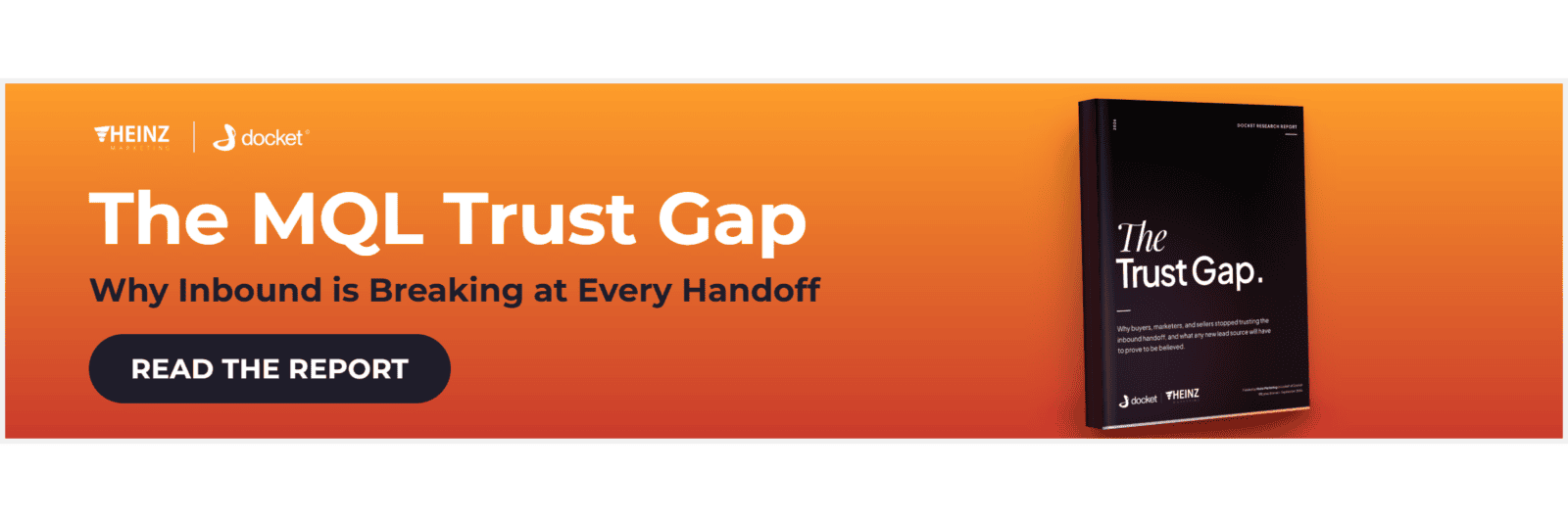
More than 80% of respondents abandoned a vendor form in the past 90 days, most of them more than once. Roughly two-thirds of that abandonment traces to contact demands, meaning phone numbers, personal emails, and the sales outreach buyers expect to follow, while field count accounts for about 1 in 8. Trimming a form from 9 fields to 5 leaves the part buyers are declining in place.
That loss leaves no record in any system, and the buyers who do submit aren’t always a win either. Nearly a third of respondents say a quarter or more of last quarter’s form fills were junk, and Matt Heinz admitted during our webinar that if a form insists on his email, his first name may arrive with 3 t’s.
Chatbots haven’t closed that gap, since two-thirds of buyers who opened one in the past 90 days gave up without getting what they came for. Only 2% said they would rather browse a vendor site with no conversation at all, so the appetite for a real conversation is still there.
Handoff 2: Marketing Sends a Number Nobody Believes
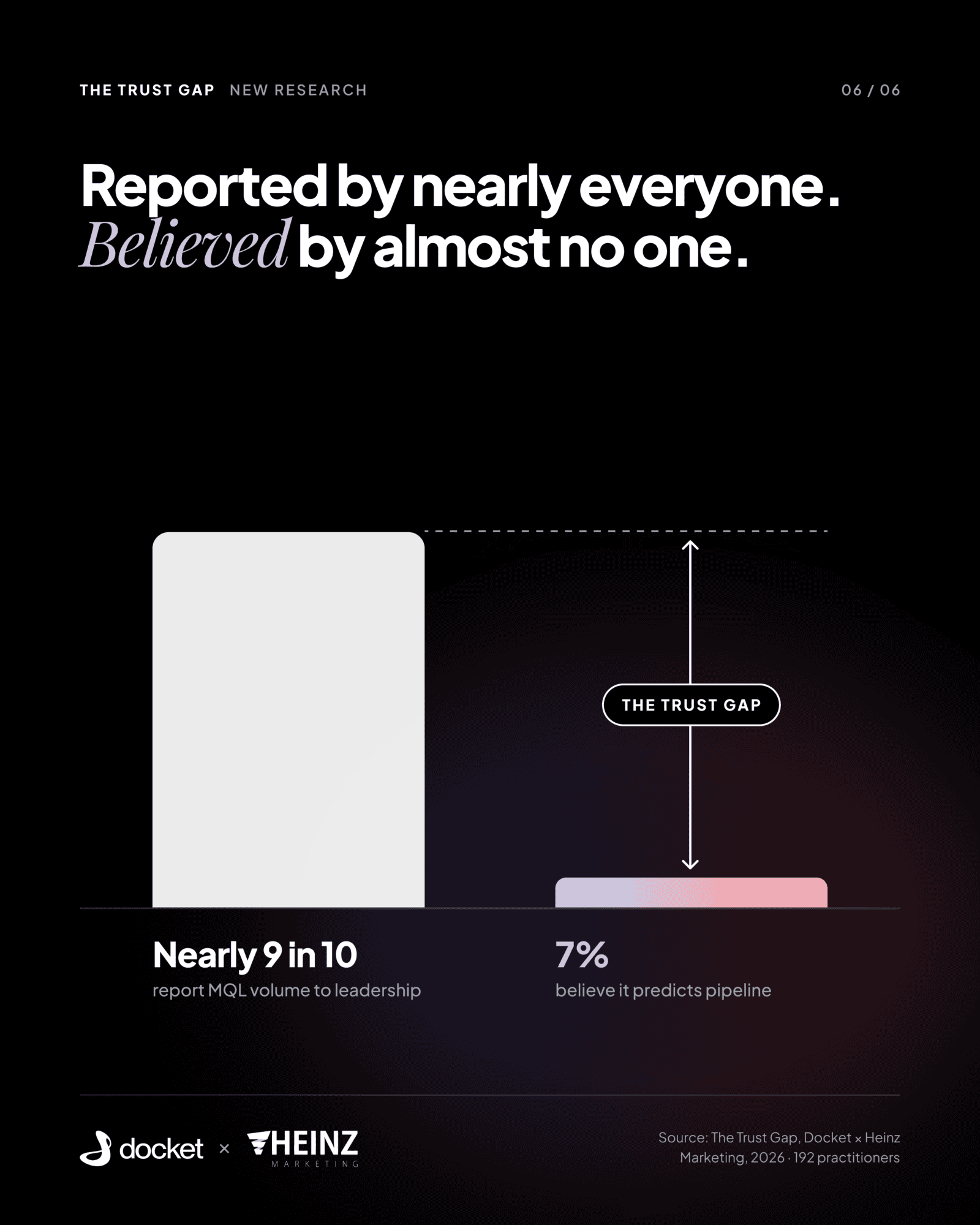
Nearly 9 in 10 respondents report MQL volume to leadership. Among those who do, 7% are confident the number predicts real pipeline, and the bulk of the rest describe themselves as only slightly confident.
At 78% of organizations, sales rejects more than half of the MQLs marketing sends, and roughly two-thirds of respondents would redefine or drop the MQL if they rebuilt their reporting from scratch. Lauren McHugh, Head of Marketing at Docket, offered a candid explanation for why it persists: it’s easier to keep producing a number you don’t fully trust than to be the person who replaces it, since that change takes more than a quarter to align on.
Handoff 3: Follow-Up Rarely Lands
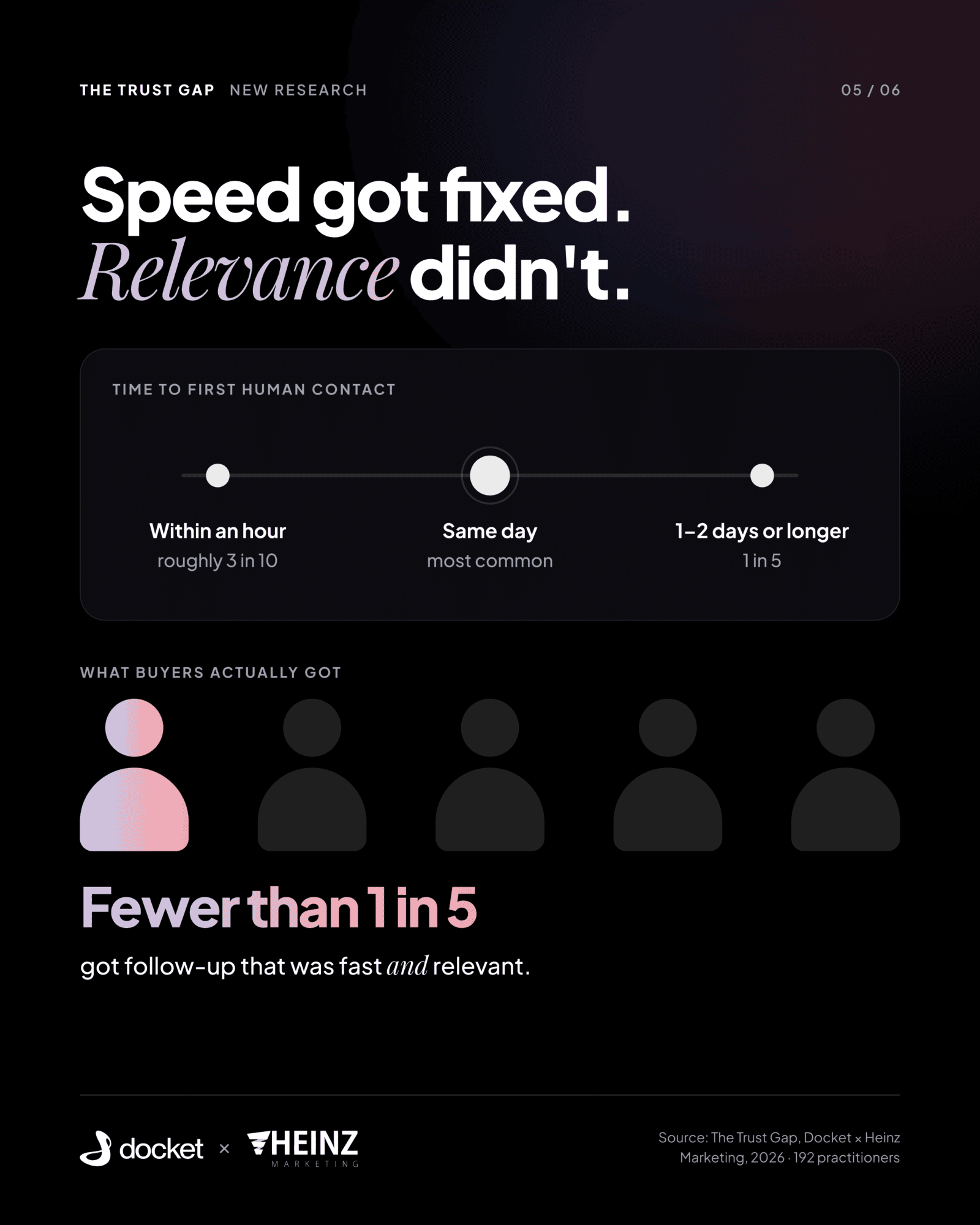
Asked about their own most recent form fill, fewer than 1 in 5 respondents received follow-up that was fast and relevant, and most got a generic sequence, slow follow-up, or nothing at all. These are marketing and RevOps professionals describing systems very much like the ones they run.
Speed is only part of the problem, since roughly 3 in 10 organizations make first human contact within an hour and buyers still describe the experience as mostly generic. Lauren’s read is that context is the bigger gap, because reps often don’t know what the buyer looked at or cares about, so follow-up defaults to a template. Timing matters in a less obvious way too, since a little over half of organizations running an agent say a quarter or more of agent-booked meetings happen outside staffed business hours.
AI Is Arriving Faster Than the Ability to Measure It
Among respondents, 7 in 10 are piloting, deploying, or scaling an AI agent, most often to qualify visitors and run discovery. Fewer than 4% named leadership skepticism as the biggest barrier, while stack connectivity tops the list and becomes more visible with experience, named by 47% of deployed teams compared with 13% of teams still researching.
Measurement is the thinner layer. About 1 in 10 organizations running an agent reads results from a dashboard or CRM report, and half calculate them by hand. When respondents compared sales acceptance of agent-booked meetings with acceptance of their own MQLs, 40% came in below their MQL baseline. That figure deserves caution because the 2 measures don’t share a denominator, but it does show the newest part of the inbound system being judged against its least trusted measure.
What Any New Lead Source Has to Prove
If the MQL can’t serve as the benchmark, the study suggests what should. Respondents said timeline, an explicit next step, buying role, and current stack would make a conversation-qualified lead more actionable than a form record, and the full transcript came last at about 1 in 5. One webinar attendee said much the same from experience, noting that a short summary of key topics is far easier for BDRs to act on than a full transcript.
Leadership, meanwhile, wants downstream evidence such as pipeline conversion, win rate, and speed to meeting, and rep testimony persuades fewer than 1 in 5. Docket uses the term Agent Qualified Lead for a lead that meets this standard, and the report lays out 4 requirements that apply just as well to a form or any other source.
Four Places to Start This Quarter
None of these require a new tool, and each one can move independently of the others.
- Measure what you currently can’t see: Establish what share of your website visitors leave without a substantive conversation, and find out which contact field drives the most abandonment on your highest-traffic form.
- Define the qualification fields before you choose the capture mechanism: Agree with sales on the handful of things a rep needs before first contact, such as timeline, buying role, and next step, and deliver them where reps will actually look. Docket, for example, sends reps a summary with pain points and suggested next steps in Slack or Teams and keeps the full transcript in the CRM.
- Name an owner and scope the integration before a pilot starts: Lauren suggests giving ownership to whoever owns the success metric, usually demand gen when the goal is conversion, and settling where the data goes, what baseline you’ll measure against, and what guardrails and tone the agent should follow before launch.
- Record your form-sourced baseline now: Capture your current MQL acceptance rate and speed to meeting so a fair comparison is possible later, since speed to meeting is the earliest evidence available.
The report also includes an 8-question Inbound Trust Assessment that a team can score in a single meeting. Matt suggests having several people take it and comparing where their answers disagree. If your team lands in the lower half, you’re in good company, because that’s where most of the market sits.
Back to Tuesday Night
Nothing in this research suggests our VP is a difficult buyer. She would happily talk to a vendor’s site if it answered her questions before asking for her phone number, and the teams that close the trust gap will likely be the ones that can show what each handoff actually produced for her.
The full report covers each handoff in detail along with the complete assessment.
Take our free marketing orchestration self-audit to determine where your marketing operations are breaking down, and ping us if you’d like to discuss the results.