5 Signs Your Work Management Platform Is Running Your Marketing
 Brenna Lofquist
Summary
Large marketing organizations often turn to work management platforms to manage complexity, but when how work should flow is never defined outside the tool, the platform quietly becomes the operating model. This post walks through five signs it’s happening: inconsistent naming, mismatched statuses, notification noise, conversations in side channels, and untrustworthy data. It closes with a checklist for defining the operating model before you reconfigure anything.
By Brenna Lofquist, Senior Consultant at Heinz Marketing
Over the past few years, we’ve worked with some very large marketing organizations, and the complexity inside them is hard to overstate. Picture a company with GTM strategy organized around several solution pillars, each backed by a cross-functional team drawing on shared functions like creative, digital, events, and communications. A single campaign can pull in a dozen or more people, each with their own requests, approvals, and handoffs. Multiply that across every pillar and every campaign, and someone has to see all of it, sort it, and keep it moving.
That’s usually when a work management platform enters the picture. Boards go up, forms get built, and requests finally have a home.
When the tool becomes the operating model
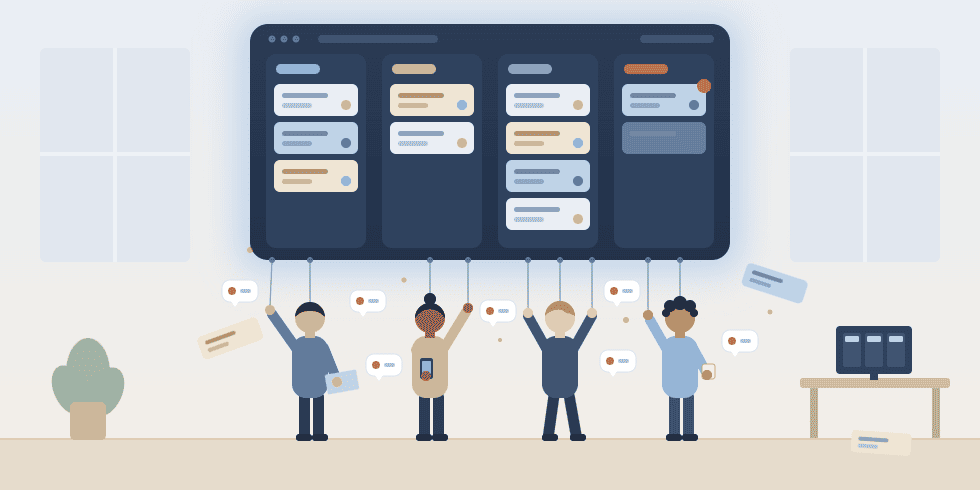
Later down the road, cracks start to show. Leadership still can’t see what’s in progress without asking around. The same request lives on three boards with three different statuses. The conversations that matter (what are the specs, who’s approving this, is this even greenlit?) drift back into chat threads and side emails.
A work management platform is great at tracking work. It’s not designed to decide how work should flow, who owns each handoff, or what “done” means. When those decisions never get made outside the tool, the platform makes them by default. Before long, the tool is the operating model, and nobody chose it.
The good news is that this pattern leaves clear fingerprints. Here are five signs your platform is running your marketing orchestration, and what to do about it.
Over the past few years, we’ve worked with some very large marketing organizations, and the complexity inside them is hard to overstate. Picture a company with GTM strategy organized around several solution pillars, each backed by a cross-functional team drawing on shared functions like creative, digital, events, and communications. A single campaign can pull in a dozen or more people, each with their own requests, approvals, and handoffs. Multiply that across every pillar and every campaign, and someone has to see all of it, sort it, and keep it moving.
That’s usually when a work management platform enters the picture. Boards go up, forms get built, and requests finally have a home.
Symptom 1: Nobody names things the same way
Searching for a campaign? You’ll find it named three different ways. There’s no consistent naming convention and no unique ID, so finding a campaign means scrolling, guessing, or asking whoever submitted it.
This seems cosmetic, but it isn’t. If work can’t be found, it can’t be reported on, and leadership ends up relying on people to reconstruct the picture by hand. The fix starts outside the tool: agree on what a request is called, what identifies it, and who enforces the standard. Then let the platform automate it.
Symptom 2: Statuses mean something different on every board
Work moves from strategy to production, with tasks landing on multiple boards, each with its own status options. “In progress” on one team means drafting. On another, it means waiting on approval. When a request transitions across teams, it loses its meaning in transit.
The result is that nobody can answer a simple question: where is this, really? Shared stage definitions, agreed on before anyone configures a board, give work a common language as it moves. Teams can still run their own internal steps, but the handoff points mean the same thing everywhere.
Symptom 3: Notifications have become noise
People are tagged on work that hasn’t been approved yet. They get alerts for tasks that don’t have sufficient information. Eventually, they do the only sensible thing and start ignoring notifications altogether, including the ones that matter.
This is usually a triage problem disguised as a settings problem. When every request generates tasks the moment it’s submitted, the system fills up with work that may never happen. Qualifying and prioritizing requests before they enter the platform cuts noise more than any notification setting can. When only greenlit work generates tasks, an alert means something again.
Symptom 4: The real conversations happen somewhere else
A designer needs images for a banner. A writer isn’t sure who approves the final copy. Nobody knows where to look, so the questions move to a chat thread or side email, or come up in a meeting. The work gets done there and the platform never finds out.
This is the clearest sign that process was never defined outside the tool. When people don’t have answers to basic questions about format, ownership, and approval, they go wherever they can get answers fastest. Documented deliverable definitions and clear decision rights at each handoff bring those conversations back where they can be seen.
Symptom 5: The data can’t be trusted
Tasks don’t get marked as complete. Subtasks stay overdue after the parent task wrapped up. Duplicate tasks exist across teams for the same initiative. So when leadership pulls a report on turnaround time or workload, the numbers are wrong and everybody knows it.
Bad data in a work management platform is almost never a reporting problem. It’s an accountability problem upstream: no clear owner for keeping work current and no shared expectation of what “done” looks like. Before investing in better dashboards, define who is responsible for data hygiene at each stage, and make closing out work part of the process rather than an afterthought.
The root cause
Decisions that were never made. Look at the five symptoms together, and a pattern appears. None of them are really about the platform. Each one traces back to a decision that should have been made at the operating-model level and wasn’t: what we call things, what each stage means, what qualifies as real work, who answers which questions, and who keeps the record accurate.
It’s easy to see how this happens. Platforms are usually rolled out under pressure, when the volume of work is already overwhelming. Each team builds its own space to solve its own immediate problem. Reorganizations shift people and responsibilities, but the boards stay the same. Nobody is wrong, exactly. However, without shared decisions underneath, every team’s configuration becomes a small, local answer to a question the whole organization needed to answer together.
The fix isn’t a new tool or a bigger rollout. It’s making those decisions explicitly, outside the platform, and then configuring the platform to reflect them. The tool should carry the handoffs. People should make the decisions.
A checklist before you configure anything
Before you rebuild boards, add automations, or switch platforms, ask your team these questions:
- Could someone describe how a campaign moves from request to launch without opening the tool?
- Do teams agree on what each stage means when work changes hands?
- Is there one clear owner at every handoff, and do they know it?
- Are requests qualified and prioritized before they generate tasks?
- Do your most common deliverables have shared definitions, including specs, inputs, and approvers?
- Is someone accountable for keeping work current, including closing it out?
- If leadership asked for a status report today, would anyone trust the data?
If you answered “no” or “not sure” to more than a couple of these, the next step isn’t reconfiguration. It’s defining the operating model the platform should support.
Wrapping up
Large marketing organizations are complex by nature, with multiple pillars, shared functions, and dozens of people touching a single campaign. A work management platform can make that complexity manageable, but only if it’s built on decisions the organization has actually made. When those decisions are missing, the symptoms show up fast: inconsistent naming, statuses that mean different things, notification noise, conversations in side channels, and data nobody trusts.
The good news is that these problems are fixable, and the fix usually costs less than a new platform. Start by defining how work should flow, then make the tool reflect it.
Want to see where your organization stands? Take our complimentary marketing orchestration self-assessment or learn more about our Marketing Orchestration services.